
When Your Baby Hates Tummy Time, Cries on Their Tummy or Struggles to Lift Their Head
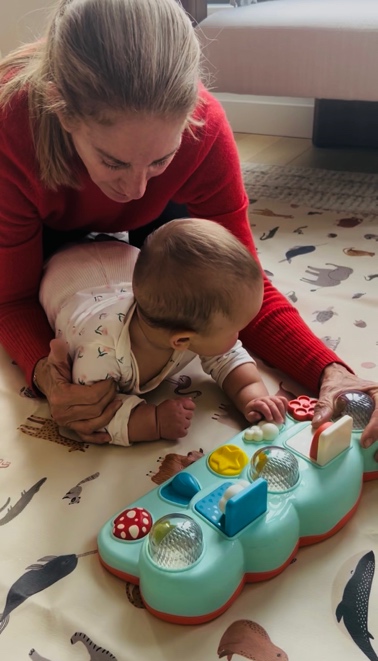
“My baby hates tummy time” is one of the most common concerns I hear from parents.
Your baby may cry almost immediately when you place them on their stomach. They may keep their face close to the floor, pull their arms backward, stiffen their body, or seem to work incredibly hard just to lift their head. Parents are often told to “do more tummy time.” When a baby consistently struggles, I want to understand why tummy time is so difficult rather than simply asking you to keep your baby there longer. Through Motor Skills Matter, I provide pediatric physical therapy for babies with tummy time difficulties, torticollis, head-shape concerns, body tension, low muscle tone, and early motor-development concerns throughout NYC and the Hamptons.
Why Is Tummy Time Important?
Tummy time gives your baby an early opportunity to work against gravity. While awake and supervised on the tummy, your baby begins learning to lift and control the head, turn in both directions, bear weight through the forearms and hands, strengthen the shoulders and trunk, shift weight, reach, and eventually push through the arms and move across the floor. These early experiences contribute to skills your baby will later use for rolling, sitting, transitions, crawling, and exploring. I don't look at tummy time simply as a number of minutes to accumulate. How your baby moves and what they are able to do during that time matter too.
Why Does My Baby Hate Tummy Time?
There isn't one reason. For some babies, tummy time is simply hard work. For others, something specific makes the position much more challenging. I look at your baby's head and neck control, torticollis or a head-turning preference, head shape, body tension, muscle tone, strength, ability to bear weight through the arms, trunk rotation, movement symmetry, and overall motor development. Prematurity, reflux, feeding-related discomfort, and sensory responses may also affect how comfortable your baby is in the position. Rather than assuming your baby just doesn't like tummy time, I want to understand what is making it difficult.
My Baby Cries Every Time We Do Tummy Time
Crying doesn't necessarily mean tummy time is harmful. Your baby may be telling you that the position is difficult, unfamiliar, tiring, or frustrating. I don't believe the answer is to leave a distressed baby on their tummy simply to reach a certain number of minutes. Short, successful opportunities repeated throughout the day may be more useful than one long session that ends in significant crying. As your baby becomes stronger and more comfortable, those periods can gradually become longer. I want tummy time to become more successful, not simply longer.
What If My Baby Just Lies There?
Very young babies aren't expected to immediately push up high and look around the room. Early tummy time may involve very small movements. Your baby may briefly lift the head, turn from side to side, begin bringing the elbows closer under the shoulders, or push slightly through the forearms. With time and practice, head control should become easier and your baby should begin interacting more actively with the environment. If your baby consistently keeps their face down, has difficulty turning the head comfortably, or shows little progression over time, I may want to take a closer look.
What If My Baby's Arms Go Back Like an Airplane?
Some babies lie on their tummy with both arms pulled backward instead of bringing the elbows forward to support the upper body. Parents sometimes call this “airplane arms.” This pattern can be related to shoulder stability, trunk control, weight shifting, strength, body awareness, or simply how your baby has learned to organize their body in tummy time. Putting your baby on their stomach more often doesn't necessarily change the pattern. Sometimes a small adjustment in positioning makes it much easier for your baby to bring the arms forward and begin using the forearms for support.
Tummy Time and Torticollis
If your baby has torticollis or a strong head-turning preference, tummy time may be more challenging. You may notice that your baby consistently looks toward one side, has difficulty turning the other way, tilts the head, shifts weight unevenly, or uses one arm differently. Torticollis is not only about neck movement. A persistent head preference can influence how your baby begins using the shoulders and trunk as new motor skills develop. Tummy time gives me a useful opportunity to see these early differences between the two sides.
Tummy Time and Flat Head Syndrome
If your baby has plagiocephaly, you may have been encouraged to increase tummy time because it gives your baby time away from pressure on the back of the head while encouraging active movement. That advice can be frustrating when every attempt at tummy time ends in crying. A baby with a head preference, torticollis, weakness, or difficulty supporting the upper body may need help becoming more comfortable and active in the position.
Tummy Time and Body Tension
Some babies look surprisingly strong in tummy time because they lift the head very high at an early age. Sometimes that appearance of strength comes from using a strong extension pattern. You may see your baby arch the back, pull the shoulders backward, straighten the legs, push the head backward, or have difficulty bringing the arms forward and hands toward midline. Lifting the head high doesn't necessarily mean your baby has developed good postural control. I want to see your baby gradually learn to control movement through a variety of positions rather than relying primarily on stiffness or extension.
Tummy Time and Low Muscle Tone
Babies with low muscle tone may have a different challenge. Working against gravity can take considerably more effort. Your baby may rest the head frequently, have difficulty pushing through the forearms, keep the arms wide, tire quickly, or make slower progress with head control and tummy time. I don't necessarily want these babies pushed harder. Instead, I look for the right amount of support and challenge so your baby can participate actively without becoming so tired that movement quality begins to deteriorate.
Tummy Time for Premature Babies
After a NICU stay, tummy time may feel especially difficult. A premature baby may have had fewer opportunities for unrestricted movement and may also have medical, feeding, or developmental considerations that affect early motor experiences. I consider corrected age when looking at developmental expectations, but I don't use age alone. I also look at your baby's muscle tone, strength, head control, body tension, movement symmetry, medical history, and overall developmental progression. I want tummy time to progress according to your baby's individual abilities rather than comparing your baby rigidly with a full-term baby of the same chronological age.
What About Reflux?
Some babies are uncomfortable in tummy time because of reflux or feeding-related discomfort. Timing may make a difference, and your baby may tolerate the position better when it isn't attempted immediately after a full feeding. Significant reflux, feeding refusal, choking, gagging, swallowing concerns, poor weight gain, or signs of pain should be discussed with your pediatrician or feeding professional. I can help with positioning and motor development, but physical therapy doesn't replace medical evaluation of feeding or gastrointestinal concerns. Tummy time is for supervised awake periods only. Your baby should still be placed on their back for sleep on an appropriate firm, flat sleep surface.
Does Tummy Time Have to Be Flat on the Floor?
Not at first. If your baby is very young or struggling with tummy time, I may modify the position so they can begin participating more successfully. Your baby may start on your chest, across your lap, or with carefully placed support under the upper chest while awake and supervised. The amount of support depends on your baby's age and abilities. As strength and control improve, I gradually reduce the support so your baby does more of the work. The longer-term goal is independent movement and play on a safe floor surface.
What About Tummy Time Pillows and Wedges?
A small amount of support can sometimes make tummy time easier, but I use props thoughtfully. A pillow, roll, or wedge used for developmental positioning should only be used while your baby is awake and directly supervised. These are not sleep-positioning devices. I also don't want a prop to become something your baby always needs. It can provide temporary support while your baby develops the strength and control to do more independently.
How Much Tummy Time Does My Baby Need?
Parents often want a specific number, but I don't want you spending the day watching the clock while missing what your baby is actually doing. I want tummy time to become a regular part of your baby's supervised awake movement. As your baby grows stronger, they will generally tolerate longer periods and spend more time actively playing on the tummy. I look at both how often your baby has opportunities to practice and what happens during those opportunities. Active lifting, turning, pushing, reaching, and interacting tell me much more than time spent crying with the face against the floor.
Tummy Time Is Only One Part of Floor Play
Tummy time gets a lot of attention, but your baby needs opportunities to move in many different positions. Playing on the back, side-lying, reaching for toys, bringing the hands toward midline, kicking, rolling, turning the head, playing with the feet, and beginning to move between positions all provide valuable movement experiences. Motor development comes from movement variety, not from one exercise.
Baby Equipment and Tummy Time
Swings, bouncers, seats, strollers, and other baby equipment can be useful. You need safe and practical places to put your baby during the day. My concern isn't that using a bouncer for a short period will harm your baby's development. I look at whether supported equipment is gradually replacing opportunities to move independently. When possible, I encourage families to balance necessary equipment use with something very simple: a safe space on the floor where your baby has the freedom to move.
What If My Baby Rolls Out of Tummy Time?
Once your baby learns to roll, they may immediately roll out of tummy time. I see that as movement, not something you necessarily need to prevent. You don't have to spend the day repeatedly flipping a mobile baby back onto the stomach. Instead, make tummy play interesting. Place a toy slightly to the side, get down on the floor, use a mirror, or encourage reaching so your baby has a reason to stay and explore. As babies become more mobile, I focus less on keeping them in a prescribed position and more on creating opportunities that encourage them to move.
When Might a Tummy Time Evaluation Be Helpful?
I may recommend taking a closer look if your baby becomes extremely distressed every time they are placed on the tummy, has persistent difficulty lifting or turning the head, consistently looks toward one side, has a head tilt or flattening, uses one arm differently, or has difficulty bearing weight through the forearms. I would also want to look more closely if your baby seems unusually stiff or floppy, frequently arches, shows very little progression, or consistently moves differently on the two sides. You don't have to wait until your baby misses a milestone before asking about something you are noticing.
What Do I Evaluate?
A tummy time evaluation involves much more than seeing how high your baby can lift the head. I look at head position, neck rotation, head tilt, head shape, muscle tone, body tension, strength, trunk control, shoulder stability, forearm support, hand position, midline control, weight shifting, reaching, visual tracking, rolling, movement symmetry, and overall motor development. I also want to understand your baby's history. Pregnancy, birth, prematurity, a NICU stay, feeding, reflux, sleep, carrying positions, equipment use, and daily routines can all provide useful context. Looking at these pieces together often helps me understand why tummy time is difficult for your baby.
How Can Pediatric Physical Therapy Help?
What I work on depends on what is making tummy time difficult for your baby. Treatment may focus on head control, neck mobility, shoulder stability, forearm support, weight shifting, reaching, trunk rotation, midline control, movement symmetry, or strength. I may also show you positioning and handling strategies that fit naturally into your everyday routines. I don't want you doing a complicated exercise program several times a day. I want to help your baby experience movement in ways that are successful, varied, and useful for development.
Don't Fight Your Baby Through Tummy Time
If every tummy time session becomes a battle, repeating the same approach may not be the best solution. Sometimes I change the position, amount of support, timing, arm placement, toy position, or how long your baby stays there. A small adjustment can make a difficult position much more manageable. Babies learn through repetition, so I want your baby repeatedly practicing useful movement rather than repeatedly experiencing distress.
Does Every Baby Who Hates Tummy Time Need Physical Therapy?
No. Many babies dislike tummy time at first and gradually become more comfortable as they get stronger. If your baby is progressing, moving symmetrically, and gradually tolerating more floor play, ongoing physical therapy may not be necessary. Sometimes you may simply need reassurance and a few practical suggestions. In other cases, one developmental consultation may be enough. My goal isn't to keep every baby in therapy. It is to determine what your baby needs.
In-Home Tummy Time Physical Therapy in NYC & the Hamptons
One advantage of seeing your baby at home is that I can see where tummy time and floor play actually happen. I can look at your play mat, floor space, toys, baby equipment, your baby's usual positions, and how you pick your baby up and put them down. I can also see how these movement opportunities fit into your baby's normal routine. That allows me to suggest realistic changes you can actually use throughout the day. Through Motor Skills Matter, I provide individualized in-home pediatric physical therapy for babies with tummy time difficulties throughout NYC and the Hamptons.
Why Choose Motor Skills Matter?
I am Dr. Tara Liddle, PT, MA, DPT, PCS, a Board-Certified Pediatric Clinical Specialist with more than 30 years of experience working with babies and children. My background includes 19 years in NICU and neonatal developmental follow-up, with extensive experience evaluating early infant movement, positioning, muscle tone, and motor development. I am NDT certified and have advanced training in pediatric movement and neuromuscular treatment. I am the author of Why Motor Skills Matter: Improve Your Child's Physical Development to Enhance Learning and Self-Esteem and a contributing author of the chapter “Physical Therapist Management of Cerebral Palsy” in Contemporary and Global Perspectives in Physical Therapy: Incorporating Clinical Practice Guidelines, published by Springer Nature. My approach goes beyond asking whether your baby has reached a milestone. I want to understand how your baby is moving and what may be making movement difficult.
Frequently Asked Questions About Tummy Time
- Why does my baby hate tummy time?
- For some babies, tummy time is simply hard work. Others may struggle because of limited head control, torticollis, body tension, low muscle tone, weakness, reflux, prematurity, or movement asymmetry. If tummy time continues to be extremely difficult or your baby isn't progressing, I can look more closely at what may be contributing.
- Is it okay if my baby cries during tummy time?
- A little frustration can happen when your baby is learning something difficult, but tummy time doesn't need to become a prolonged crying session. I generally prefer shorter, more successful opportunities that give your baby a chance to actively participate. As your baby becomes more comfortable and capable, the time can gradually increase.
- What if my baby won't lift their head during tummy time?
- Very young babies may lift their head only briefly, and that can be appropriate early on. Head control should gradually improve with development and experience. If your baby continues to have difficulty lifting or turning the head as development progresses, I would consider discussing it with your pediatrician or having a pediatric physical therapy evaluation.
- Does tummy time have to be on the floor?
- Not initially. A young baby or a baby who is struggling may start with modified tummy time on your chest, across your lap, or with appropriate support while awake and supervised. I gradually work toward more independent floor-based tummy time as your baby's strength and control improve.
- Can I use a tummy time pillow?
- A small support can sometimes help your baby begin using the arms and lifting the head. Any prop should be used only during supervised awake play and never as a sleep-positioning device. I generally use support as a temporary tool rather than something your baby continues to rely on.
- My baby rolls immediately out of tummy time. Should I keep putting them back?
- Not necessarily. Once your baby can roll independently, rolling out of tummy time is a motor skill. Instead of repeatedly putting your baby back, I would make tummy play more interesting with toys, reaching, mirrors, and interaction so there is a reason to stay and explore.
- Can torticollis make tummy time harder?
- Yes. Limited neck movement or a strong head-turning preference can make tummy time more difficult. Your baby may also shift weight unevenly or use the arms differently. I look at these patterns when I evaluate a baby who consistently struggles in tummy time.
- Can reflux make tummy time uncomfortable?
- It can for some babies, especially immediately after feeding. You may find that your baby tolerates tummy time better when awake and comfortable rather than directly after a full feeding. Significant reflux or feeding concerns should be discussed with your baby's pediatrician.
- Is tummy time important for crawling?
- Tummy time gives your baby opportunities to develop head and trunk control, upper-extremity weight bearing, shoulder stability, weight shifting, and reaching. These are useful skills for later floor mobility. Babies can follow different developmental pathways, however, so I don't present tummy time as a guarantee that your baby will crawl in one particular way.
- Does my baby need physical therapy because they hate tummy time?
- Not necessarily. Some babies simply need more time or a few changes in positioning. I consider physical therapy when tummy time difficulty occurs along with torticollis, asymmetry, low muscle tone, unusual stiffness, weakness, head-shape concerns, or delayed motor development.
Tummy Time Should Become an Opportunity to Move
Tummy time isn't a test your baby has to pass, and I don't want it to become a competition over minutes. It is an early opportunity for your baby to begin lifting the head, turning, pushing, shifting weight, reaching, and discovering how to move against gravity. When tummy time is difficult, the answer isn't always more tummy time. Sometimes I need to understand why it is difficult first, then help your baby find a more comfortable and effective way to participate. Through Motor Skills Matter, I provide expert in-home pediatric physical therapy for babies with tummy time difficulties in NYC and the Hamptons.
Schedule an infant physical therapy or Baby Wellness & Developmental Checkup with Dr. Tara Liddle.