
Supporting Motor Development in Babies and Children in NYC & the Hamptons
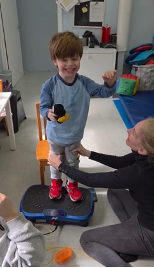
Learning that your baby or child has a genetic diagnosis can bring many questions. What will development look like? When will my baby sit, crawl, or walk? How much should I help? Should we be working on strength? Is low muscle tone affecting development? What equipment might be helpful? Sometimes families begin physical therapy before they have a definitive diagnosis because their baby or child is already showing differences in muscle tone, strength, movement, or motor development. A diagnosis can provide important medical information. Physical therapy, however, starts with the child in front of me.
A Diagnosis Does Not Tell Us Everything About a Child
Children with the same genetic diagnosis can have very different abilities and developmental paths. One baby may have significant hypotonia but steadily progress through motor milestones. Another child with the same diagnosis may have greater weakness, joint instability, orthopedic concerns, or medical complexity. That variability is why I don't treat a diagnosis. I evaluate your individual child and how their body functions. I want to understand what your child can do now, what is difficult, what may be limiting progress, and which skills could make the greatest difference in everyday life. The diagnosis gives me context. Your child's abilities, needs, medical history, and goals guide treatment.
Why a Child With a Genetic Disorder May Need Physical Therapy
Genetic and developmental conditions can affect movement in many different ways. A baby may have low muscle tone or weakness that makes head control, tummy time, rolling, or sitting more difficult. Another child may have increased joint mobility and need more active stability to maintain posture or stand. As development progresses, difficulties may become more noticeable during transitions, crawling, pulling to stand, walking, stairs, balance, or activities requiring greater endurance. Some children have foot and ankle instability or orthopedic concerns. Others may eventually benefit from orthotics, supportive seating, standing equipment, gait trainers, or another mobility device. Not every child with a genetic diagnosis will experience all, or even many, of these challenges. Physical therapy should address the individual child's functional needs, not a checklist associated with the diagnosis.
Sometimes Physical Therapy Begins Before the Diagnosis
Not every family comes to me with an established genetic diagnosis. Sometimes the first concerns are developmental. A parent or pediatrician may notice significant hypotonia, unusual weakness, joint laxity, asymmetry, or motor delays. Your child may already be undergoing neurological, genetic, or other medical evaluation. Physical therapy doesn't necessarily need to wait until every diagnostic question has been answered when there are functional movement needs that can appropriately be addressed. At the same time, physical therapy should never substitute for medical investigation. If your child's weakness, muscle tone, movement pattern, or developmental history raises concerns beyond an isolated motor delay, I will share those observations and encourage appropriate medical follow-up.
Hypotonia and Genetic Disorders
Low muscle tone is associated with many genetic and developmental conditions, but hypotonia isn't the same as weakness. A baby with lower muscle tone may need to work harder to maintain the head and trunk against gravity. If weakness is also present, movement may require even more effort. Some children with hypotonia also have increased joint mobility. Their muscles must provide additional active stability around the joints, and they may develop strategies that help them feel more secure. You may see wider sitting positions, locked knees, heavy reliance on the arms, or a preference for positions that provide more external support. Physical therapy doesn't eliminate underlying low muscle tone. I work on developing strength, postural control, balance, joint stability, and functional movement so your child can use their body as effectively as possible.
Joint Laxity and Alignment
Increased joint mobility occurs with some genetic conditions and can influence how a child sits, stands, balances, and walks. I may see a child use a wide base for stability, hyperextend the knees, pronate significantly through the feet, or rely heavily on furniture or another person for support. Ankle instability or difficulty maintaining alignment may make standing and walking more tiring. Supportive footwear, orthotics, or other external support may be helpful for some children, but these decisions should be individualized. I want to provide enough support to improve alignment and function while still allowing your child to actively develop strength and control.
Building the Foundations for Motor Development
When a baby has significant developmental challenges, it is understandable to focus on major milestones such as sitting, crawling, standing, and walking. Those goals matter to me too. But sometimes we need to develop smaller components before the larger skill becomes possible. Before independent sitting, for example, your baby may need better head control, trunk activation, weight shifting, shoulder stability, or the ability to use the arms for support. Before standing, we may need to work on trunk and hip control, kneeling, transitions, and the ability to bear weight effectively through the legs. Breaking a complex movement into smaller, achievable components can help your child build toward a meaningful functional goal.
Movement Quality Still Matters
When a child has a developmental diagnosis, it is easy for everyone to focus on whether the next milestone has been achieved. I am interested in the milestone, but I am also interested in how your child accomplishes it. Children are excellent problem solvers. Your child may discover a way to sit, stand, crawl, or move across the floor using a strategy that works very well for them. Compensation isn't automatically something that needs to be corrected. I look at whether the strategy supports independence or whether it requires excessive effort, creates instability, or limits other movement options. My goal isn't to make every child move according to one definition of “normal.” I want to help your child develop movement that is as efficient, varied, functional, and independent as possible for them.
Physical Therapy Should Challenge Without Overwhelming
More therapy or more exercise isn't automatically better. Children with genetic or developmental conditions may have differences in strength, endurance, sensory processing, cardiopulmonary function, or medical tolerance that affect how much activity is appropriate. I want movement to be challenging enough to encourage development without creating excessive fatigue or causing movement quality to deteriorate. For a baby, that may mean short periods of purposeful activity repeated throughout the day. For an older child, it may mean balancing strengthening, functional mobility, and endurance work with appropriate recovery. Your child's medical history, energy level, and response to activity should always be part of treatment planning.
What a Pediatric Physical Therapy Evaluation Includes
I begin by learning about your child and your family's concerns. When relevant, I review the medical diagnosis, birth and developmental history, genetic findings, specialists involved in your child's care, previous therapy, current equipment, and the movement challenges you are seeing at home. I may use standardized developmental measures when appropriate, but I combine them with clinical observation. A developmental score gives me one type of information. Watching how your child solves a movement problem gives me another. Depending on your child's age and abilities, I may look at muscle tone, strength, range of motion, joint stability, posture, balance, alignment, endurance, transitions, floor mobility, standing, walking, gait, stairs, and overall functional movement.
What Treatment Looks Like
Treatment depends on your child. For an infant, sessions may include positioning, tummy time, reaching, rolling, sitting, weight shifting, trunk control, and transitions. As your baby's abilities develop, we may work on floor mobility, crawling, kneeling, pulling to stand, standing, and early walking. For an older child, treatment may focus more on functional strength, balance, gait, endurance, stairs, transfers, mobility, and participation in everyday activities. Treatment should change as your child changes. I don't want to keep repeating an exercise simply because it is part of a standard program for a particular diagnosis. The activities should have a reason and connect to what your child is working toward.
Equipment Should Support Function
Some children with genetic conditions benefit significantly from adaptive equipment. Supportive seating, standing equipment, gait trainers, orthotics, or other mobility devices can give a child opportunities for positioning, mobility, and participation that might otherwise be difficult. Equipment isn't a sign that therapy has failed. I also don't believe in adding equipment simply because a child has a particular diagnosis. I want to know what the equipment will help your child do. Will it improve alignment or stability? Will it increase independence? Will it create more opportunities for movement? Will it help your child participate with family or peers? Can it provide useful support without unnecessarily restricting active movement? Function should guide the decision.
Working With Your Child’s Medical and Therapy Team
Children with genetic and complex developmental conditions may have several professionals involved in their care. Depending on your child's needs, that team may include your pediatrician and specialists in genetics, neurology, orthopedics, physiatry, cardiology, or pulmonology. Occupational therapists, speech-language pathologists, Early Intervention providers, school therapists, and orthotists may also play important roles. Communication becomes particularly important when medical needs are complex. Private pediatric physical therapy can complement your child's existing medical, Early Intervention, school, and therapy services. It doesn't replace them. The goal is coordinated care centered on your child and your family's priorities.
Supporting Parents Without Making Home Life Feel Like Therapy
Families of children with complex developmental needs may already have many appointments, recommendations, and home programs. You are your child's parent. You shouldn't have to feel like a therapist every minute of the day. I prefer to identify a manageable number of activities or positioning strategies that fit naturally into your routines. A diaper change may provide an opportunity to practice rolling. Reaching for a favorite toy can encourage weight shifting. Moving between the floor and a low surface can work on transitions. Playing at the couch can become an opportunity to kneel or stand. I want to create more opportunities for purposeful movement without turning every interaction with your child into an exercise session.
Progress Looks Different for Every Child
Progress shouldn't be defined solely by the age at which a milestone is achieved. For one child, progress may mean sitting independently. For another, it may mean holding the head upright for longer periods or reaching outside the base of support without losing balance. Progress might mean moving from sitting to the floor, standing with less assistance, taking several independent steps, walking farther before becoming tired, or using a mobility device more independently. Sometimes the most meaningful change is that your child can participate more easily in family life. I measure progress against your child's starting point, functional goals, and abilities rather than comparing your child with someone else's developmental path.
In-Home Pediatric Physical Therapy in NYC & the Hamptons
The home environment provides valuable information when I work with a child who has a genetic or developmental condition. I can see where your child plays, how they move between spaces, what equipment they use, and which physical challenges come up during everyday routines. Furniture, stairs, toys, and familiar spaces can become part of treatment. That allows us to work on skills your child actually needs in daily life. Through Motor Skills Matter, I provide individualized in-home pediatric physical therapy for babies and children with genetic disorders, syndromes, and developmental differences throughout NYC and the Hamptons.
Why Choose Motor Skills Matter?
I am Dr. Tara Liddle, PT, MA, DPT, PCS, a Board-Certified Pediatric Clinical Specialist with more than 30 years of experience working with babies and children. My background includes 19 years in NICU and neonatal developmental follow-up, as well as extensive experience working with children with neurological, genetic, and complex developmental conditions. I am NDT certified and have advanced training in pediatric movement and neuromuscular treatment. I am the author of Why Motor Skills Matter: Improve Your Child's Physical Development to Enhance Learning and Self-Esteem and a contributing author of the chapter “Physical Therapist Management of Cerebral Palsy” in Contemporary and Global Perspectives in Physical Therapy: Incorporating Clinical Practice Guidelines, published by Springer Nature. My approach combines evidence-informed pediatric physical therapy with decades of clinical experience evaluating the whole child, not simply the diagnosis.
Frequently Asked Questions
- Does every baby with a genetic disorder need physical therapy?
- No. The need for physical therapy depends on your child's diagnosis, motor development, muscle tone, strength, medical history, and functional abilities. Some babies need ongoing physical therapy. Others may benefit from periodic developmental monitoring or consultation, and some may not need physical therapy at all.
- Can physical therapy start before we have a diagnosis?
- Yes, when your baby or child has functional motor needs that can appropriately be addressed. Physical therapy can work on movement and function while your child's medical specialists continue evaluating the underlying cause. PT shouldn't replace appropriate medical investigation.
- Can physical therapy change hypotonia?
- Physical therapy doesn't eliminate the underlying low muscle tone. It can help your child develop strength, postural control, stability, balance, endurance, and functional skills that make movement more effective.
- Will my child walk?
- I understand why this is one of the first questions many parents ask. The answer depends on many individual factors, including your child's diagnosis, strength, neurological and orthopedic status, medical history, and developmental progression. In some cases, it may not be possible to predict walking ability early in development. Rather than making a prediction before enough information is available, I focus on helping your child develop the strength, postural control, balance, transitions, weight bearing, and mobility skills that can support the greatest possible independence and participation.
- Should we use a stander or gait trainer?
- A stander or gait trainer can be extremely useful for some children, but equipment should be selected according to your child's individual needs, medical considerations, abilities, and functional goals. Your child's medical and therapy team can help determine whether adaptive equipment is appropriate and how it should be used.
- Does private PT replace Early Intervention?
- No. Private physical therapy can complement Early Intervention and other services. Families may seek additional expertise, another clinical perspective, targeted intervention, or support between existing services.
- How will I know whether therapy is working?
- I measure progress against your child's individual starting point and functional goals. Improved head or trunk control, strength, transitions, balance, mobility, endurance, efficiency, independence, and participation can all represent meaningful progress. The measure of success isn't whether your child develops exactly like another child. It is whether therapy is helping your child make meaningful functional gains.
Your Child Is More Than a Diagnosis
A genetic diagnosis can provide important answers. It can help your family and medical team understand why certain developmental or physical differences are occurring and guide appropriate care. But a diagnosis cannot tell you everything your child will do. When I evaluate a baby or child with a genetic or developmental condition, I want to know much more than the name of the diagnosis. I want to know what your child can do today, what makes movement difficult, what skills could make the greatest difference next, and how we can help your child participate more fully in everyday life. Sometimes that means working toward a major milestone. Sometimes it means making a current skill easier, more efficient, or more independent. The goals should belong to the child, not to the diagnosis. Through Motor Skills Matter, I provide expert in-home pediatric physical therapy for babies and children with genetic disorders, syndromes, and developmental differences throughout NYC and the Hamptons.
Contact me to schedule a pediatric physical therapy evaluation.