
Delayed Walking, Standing & Early Gait in NYC & the Hamptons
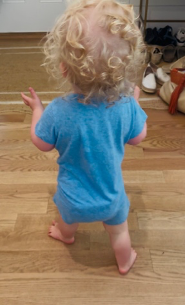
Few milestones get as much attention as a baby's first steps. You may watch another child the same age begin walking and wonder why your baby isn't there yet. Perhaps your baby cruises everywhere but won't let go, stands for a few seconds and sits back down, walks while holding your hand, or is still happily crawling at 17 months. These situations can have very different explanations. Some babies simply need more time. Others may be working through challenges with strength, balance, muscle tone, alignment, coordination, or confidence. Through Motor Skills Matter, I provide individualized pediatric physical therapy evaluations for babies and toddlers who are not yet walking or are having difficulty progressing with standing and early mobility throughout NYC and the Hamptons.
When Do Babies Usually Start Walking?
There is a wide range in when babies begin walking independently. Some take their first steps before their first birthday, while others walk considerably later. The CDC lists walking without holding on to anyone or anything as an 18-month milestone. Age is important, but it doesn't tell me everything. I also want to know what your baby is doing before walking. I look at whether your baby can pull to stand, cruise in both directions, move between pieces of furniture, lower safely to the floor, and begin standing without support. Squatting and returning to standing, bearing weight comfortably through both legs, and moving independently across the floor also give me useful information. A baby who is steadily developing these skills may be getting very close to walking. If your baby isn't walking and is also having difficulty with earlier standing or transition skills, I may want to take a closer look.
Walking Is Not One Skill
Independent walking is the result of many smaller skills coming together. Your baby needs leg and hip strength, trunk control, foot and ankle stability, balance, weight shifting, coordination, endurance, and motor planning. There is also another piece that parents sometimes underestimate: confidence. Walking requires your baby to move forward while repeatedly shifting body weight onto one leg. That is very different from standing while holding tightly to the couch. When I evaluate delayed walking, I don't simply ask whether your baby can walk. I look at the components that make walking possible.
Pulling to Stand Is an Important Step
Before independent walking, many babies learn to pull themselves upright using furniture. This requires strength through the legs and hips, trunk control, weight shifting, coordination, and the ability to transition from the floor into standing. I pay close attention to how your baby gets there. Does your baby always lead with the same leg? Do they pull primarily with the arms? Can they move through half kneeling and push through the legs, or does getting upright require a great deal of upper-body effort? These details may reveal differences in strength or symmetry that aren't as obvious once your baby is standing.
What Is Cruising?
Cruising is sideways walking while holding onto furniture. It gives your baby an opportunity to practice many of the skills needed for independent walking while still having support from the upper body. As your baby cruises, they learn to shift weight onto one leg while moving the other, adjust foot position, balance while moving, turn corners, and eventually reach between surfaces. Some babies cruise for quite a while before they are ready to let go. That time isn't wasted. Cruising can be an important period for developing balance, coordination, and confidence.
My Baby Cruises but Won’t Walk Independently
This is very common. Your baby may have enough strength to move easily along furniture but not yet have the balance or confidence to let go. Sometimes weight shifting is still difficult. Other babies become so efficient at crawling and cruising that there is very little reason to choose the harder option of independent walking. I may start by making the amount of support gradually smaller. We might bring two surfaces closer together, encourage your baby to turn away from the furniture, play with a toy using both hands while standing, practice squatting and returning upright, or take one or two steps between nearby supports. Those small successes can gradually lead to independent walking.
Standing Alone Comes Before Walking for Many Babies
Before taking independent steps, many babies learn to stand briefly without holding onto anything. At first, your baby may stand for only a second or two. Then five seconds. Then longer. Sometimes a baby will stand while distracted by a toy and immediately sit down after realizing there is no support. This is part of learning. Independent standing allows your baby to practice keeping the body's center over the feet without relying on the hands. That balance becomes an important foundation for taking a step.
Why Won’t My Baby Let Go?
Sometimes parents tell me, “I know my baby can walk. They just won't let go.” They may be right that their baby is very close. But what looks like reluctance can also be a sensible movement strategy. I look at whether your baby feels stable without support. Are the feet providing a secure base? Is your baby locking the knees, standing with a very wide base, or relying heavily on the arms? Does standing without support require a great deal of effort? Confidence matters, but confidence often grows as balance and control improve. Your baby may simply know that holding on still feels safer.
Low Muscle Tone and Delayed Walking
Babies with hypotonia may begin walking later because maintaining an upright position requires more postural control. Lower muscle tone can make it harder to stabilize the trunk, hips, knees, and ankles against gravity. Some babies with low muscle tone also have increased joint mobility. You may notice a wide base of support, pronated feet, locked knees, heavy reliance on furniture, or less controlled weight shifting. Physical therapy doesn't change your baby's underlying muscle tone. I work on helping your baby develop the strength, stability, balance, and control needed to move successfully despite it.
Foot and Ankle Stability
The feet provide the base for standing and walking. Some babies show considerable pronation or ankle instability when they first begin standing. Some foot flattening is common in young children. I become more interested when instability at the foot and ankle makes it difficult for your baby to control the body above. I look at foot position, ankle and knee alignment, weight distribution, heel contact, toe gripping, balance, and how your baby responds both barefoot and in shoes. Not every child with pronation needs orthotics. Some may benefit from supportive footwear, while others may need additional support. I base that decision on function, alignment, and stability rather than the appearance of a flat foot alone.
Toe Standing Before Walking
Many babies occasionally rise onto their toes when learning to stand. They may be excited, reaching for something, or simply experimenting with different ways to use their feet. Occasional toe standing isn't necessarily concerning. I pay closer attention when your baby spends much of standing time on the toes, has difficulty lowering the heels, develops increasing calf tightness, stands asymmetrically, or continues consistently toe walking once independent walking begins. Toe standing can have several contributing factors, so I look at the whole movement pattern rather than simply stretching the calves.
Does Crawling Affect Walking?
Crawling isn't a mandatory prerequisite for walking. Some babies crawl for months before taking their first steps, while others crawl briefly or use another form of floor mobility. I don't hold a baby back from walking because they haven't crawled “enough.” I do look at the movement skills developed during floor mobility. Can your baby shift weight, rotate, move between positions, use both sides of the body, transition from the floor into standing, and lower safely back down? Those abilities contribute to adaptable movement and are useful well beyond crawling itself.
Prematurity and Walking
If your baby was born prematurely, corrected age should be considered when looking at early developmental milestones. A baby born early may simply need additional time before independent walking emerges. Corrected age isn't the only thing I consider. I also look at your baby's NICU and medical history, muscle tone, strength, movement symmetry, previous developmental progression, and overall motor skills. Corrected age helps frame expectations. Watching how your baby moves gives me another important part of the picture.
Genetic and Developmental Conditions
Some genetic, neurological, or developmental conditions can affect when a child begins walking. Significant hypotonia, weakness, joint laxity, balance differences, or medical complexity may mean a child needs additional time and support. In these situations, I don't focus on comparing your child with a typical timeline. I focus on developing the strength, control, balance, and movement strategies that can support your child's greatest possible mobility and independence.
What If My Baby Is Otherwise Developing Normally?
Sometimes later walking is relatively isolated. Your baby may crawl well, move independently between positions, pull to stand, cruise, play, explore, communicate, and use both sides of the body. Independent steps simply haven't happened yet. In that situation, an evaluation may show that your baby is very close and needs a little more opportunity, balance practice, or confidence. Not every later walker needs ongoing physical therapy. Sometimes I evaluate a baby, reassure the family, and give them a few practical ideas to help the next step emerge.
When Delayed Walking Deserves a Closer Look
I pay more attention when delayed walking occurs along with significant weakness, unusually low or high muscle tone, persistent asymmetry, difficulty bearing weight through the legs, or difficulty pulling to stand and cruising. Foot and ankle instability, persistent toe standing, unusual movement patterns, limited overall motor progression, or other developmental concerns may also be reasons for evaluation. If your child loses a skill they previously had, I recommend contacting your child's healthcare provider promptly. You don't need to wait until a concern becomes severe before asking someone to look more closely at your child's development.
What a Delayed Walking Evaluation Includes
A walking evaluation begins long before I ask your child to take a step. I look at muscle tone, strength, joint mobility, range of motion, trunk and hip control, foot and ankle alignment, balance, weight shifting, and the ability to load each leg. I also observe floor mobility, transitions, kneeling, half kneeling, pulling to stand, cruising, squatting, independent standing, early steps, and gait when walking has begun. I pay particular attention to what happens as support decreases. A baby who can stand only while gripping furniture firmly is working through a different challenge than a baby who can stand independently but hesitates to take the first step. Understanding that difference helps me decide what your child actually needs.
How Pediatric Physical Therapy Can Help
Treatment depends on what is making independent walking difficult. For one child, I may focus on trunk and hip strength. Another may need more opportunities for weight shifting, standing balance, foot and ankle stability, or moving between surfaces. I may also work on kneeling, half kneeling, squatting, cruising, gait, and movement over different surfaces. I incorporate these skills into play whenever possible. I don't want your baby repeatedly “practicing walking” simply for the sake of taking more steps. I want to develop the movement components that allow walking to emerge with greater control.
Push Toys: Helpful or Not?
A stable push toy can be useful for a baby who is already pulling to stand and beginning to move forward in standing. I look at whether your baby can stand safely, shift weight, take steps with support, and control the speed of the toy. If your baby is leaning heavily forward, walking primarily on the toes, or being pulled along by a toy that moves too quickly, it may not be providing the experience we want. A push toy can be a useful tool. It doesn't replace the development of independent balance.
Should I Hold My Baby’s Hands to Practice Walking?
Holding your baby's hands can be fun and gives your baby experience taking steps. The problem comes when your baby's arms are held high and you are doing much of the balancing. When I help a baby walk, I gradually reduce the amount of support as control improves. I may move support from the hands to the shoulders, then the trunk or pelvis, and eventually to very light assistance. I want to give your baby just enough help to succeed while allowing them to do as much of the balancing as possible.
Do Babies Need Shoes to Learn to Walk?
In a safe indoor environment, babies can often practice standing and early walking barefoot. This allows the feet to contact the surface directly while your baby learns to balance and adjust. Shoes are important for protection outdoors. Some babies with significant foot or ankle instability may also benefit from supportive footwear. I make footwear recommendations based on your child's alignment and movement rather than assuming every new walker needs the same type of shoe.
Walkers, Jumpers and Learning to Walk
Seated infant walkers and jumping devices aren't necessary for learning to walk. Independent walking develops through active balance, transitions, weight shifting, floor movement, standing, and repeated opportunities to control the body. Your baby may enjoy these devices, but supported movement in equipment is different from independently controlling balance. I prefer to prioritize floor play, pulling to stand, cruising, squatting, and supported stepping as your baby moves toward independent walking.
Fear of Falling and Walking Confidence
Learning to walk involves taking risks and losing balance. Some babies are naturally more cautious than others. A cautious baby may spend considerable time perfecting standing before taking independent steps. I don't consider caution a problem by itself. Instead, I create small, safe movement challenges that allow confidence to develop gradually. Sometimes taking one step between two nearby pieces of furniture is enough. Confidence tends to grow through successful movement experiences.
Falling Is Part of Learning
New walkers fall frequently. Their feet are often farther apart, their arms may be held up for balance, and their steps are short while they learn how to stop, turn, and adjust to different surfaces. I expect some falling during this stage. I also look at whether your child develops protective responses and gradually becomes more controlled. If falling seems unusually frequent or forceful, or continues beyond what I would expect for your child's developmental stage, I may look more closely at balance, strength, coordination, and gait.
Early Walking Is Not a Competition
Walking is exciting, but earlier isn't automatically better. A baby who takes first steps at ten months isn't necessarily more advanced than a baby who walks later. Many motor skills are developing at the same time, and I would rather see your baby build the balance, strength, transitions, and control needed for functional movement than rush toward independent steps. The goal isn't to make your baby walk as quickly as possible. It is to help your baby become an independent and confident mover. At home, that may mean plenty of safe floor play, pulling to stand at stable furniture, cruising in both directions, squatting for toys, standing while using both hands to play, and gradually reducing support during stepping. I also like to give babies opportunities to initiate movement themselves rather than spending much of the day being walked by the hands.
In-Home Pediatric Physical Therapy for Delayed Walking
Your home is an ideal place to work on early walking because it is where your baby is already learning to move. I can use your couch, coffee table, ottoman, hallway, stairs, toys, push toys, and appropriate indoor or outdoor surfaces to see exactly how your child moves in everyday life. That allows me to show you realistic ways to create opportunities for standing, cruising, balance, and early walking without turning your home into a therapy gym. Through Motor Skills Matter, I provide individualized in-home pediatric physical therapy for delayed walking, standing, and early gait concerns throughout NYC and the Hamptons.
Why Choose Motor Skills Matter?
I am Dr. Tara Liddle, PT, MA, DPT, PCS, a Board-Certified Pediatric Clinical Specialist with more than 30 years of experience working with babies and children. My background includes 19 years in NICU and neonatal developmental follow-up, along with extensive experience evaluating infant motor development, muscle tone, strength, balance, gait, and early mobility. I am NDT certified and have advanced training in pediatric movement and neuromuscular treatment. I am the author of Why Motor Skills Matter: Improve Your Child's Physical Development to Enhance Learning and Self-Esteem and a contributing author of the chapter “Physical Therapist Management of Cerebral Palsy” in Contemporary and Global Perspectives in Physical Therapy: Incorporating Clinical Practice Guidelines, published by Springer Nature. I look beyond when your baby reaches a milestone. I want to understand how your child is developing the strength, balance, control, and confidence needed for functional movement.
Frequently Asked Questions About Delayed Walking
- My baby is 15 months and not walking. Should I worry?
- Not necessarily. Children vary in when they begin walking, and I look at whether your child is progressing with standing, cruising, transitions, and balance rather than age alone. The CDC lists walking without holding on to anyone or anything as an 18-month milestone. If your child isn't walking independently by that age, it is appropriate to discuss development with your pediatrician and consider whether a developmental or physical therapy evaluation would be helpful.
- My baby walks holding furniture but not alone. Is that delayed?
- Not necessarily. Cruising is an important stage as your baby develops the balance and weight shifting needed for independent walking. I look at whether your baby is beginning to stand with less support, move between surfaces, and continue progressing over time.
- My baby can walk holding my finger. Why won’t they walk alone?
- Your finger may provide more balance information than it seems. Even very light contact can make your baby feel more secure. Independent walking requires your baby to control the body's center without that external reference. Gradually reducing support can help bridge the gap.
- Does low muscle tone cause delayed walking?
- Low muscle tone can contribute because maintaining upright posture and joint stability may require more effort. I also consider strength, joint mobility, balance, alignment, and overall motor development rather than attributing delayed walking to muscle tone alone.
- Do flat feet delay walking?
- Not necessarily. Flat feet are common in young children. Significant foot and ankle instability may make standing and walking more difficult for some children, but I base recommendations on function and alignment rather than appearance alone.
- Should I buy special shoes?
- Most children don't need special shoes simply because they are learning to walk. If your child has significant instability or alignment concerns, I can look at how the feet and ankles function during standing and walking and make an individualized footwear recommendation.
- Can my baby walk without crawling first?
- Yes. Not every baby follows the same developmental sequence. I focus on whether your baby has developed the strength, transitions, balance, weight shifting, coordination, and movement variety needed for functional mobility.
- Should I use a push walker?
- A stable push toy can be useful for some babies who are already pulling to stand and stepping with support. It should move at a speed your baby can control and shouldn't replace opportunities to develop independent standing balance.
- Does later walking mean my child will have problems later?
- Not necessarily. Some otherwise typically developing children simply begin walking later than others. The broader developmental picture and the reason your child isn't yet walking give me much more useful information than age alone.
When Walking Hasn’t Happened Yet
It is difficult not to compare babies, especially when people keep asking, “Is your baby walking yet?” The first step is only the visible end of a much larger developmental process. Before that step, your baby has been learning to push and pull, shift weight, balance, stand, squat, turn, fall, recover, and eventually trust their body enough to let go. If walking hasn't happened yet, I don't want to simply push your baby harder. I want to understand which part of the process is still developing. Sometimes your baby needs more time. Sometimes a few changes in play and positioning are enough. And sometimes physical therapy can help develop the strength, balance, stability, or confidence needed for that next step. Through Motor Skills Matter, I provide expert in-home pediatric physical therapy for babies and toddlers with delayed walking, standing, and early gait concerns throughout NYC and the Hamptons.
Contact me to schedule an infant or toddler physical therapy evaluation.