
When Your Baby Isn’t Crawling Yet or Moves Across the Floor in an Unexpected Way
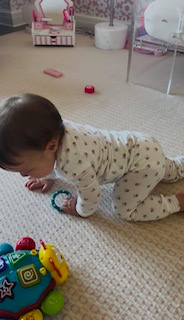
“Should my baby be crawling by now?” is a question I hear frequently.
You may be wondering why your baby is only commando crawling, scooting on their bottom, dragging one leg, or sitting independently but not getting onto hands and knees. Perhaps your baby is already pulling to stand and you are wondering whether it matters that crawling never happened. Babies don't all move across the floor in the same way, and not every variation means something is wrong. I look beyond whether your baby is crawling and pay attention to how your baby moves, changes positions, shifts weight, uses both sides of the body, and continues developing new motor skills.
Does Every Baby Have to Crawl?
Not every baby follows the same developmental path. Some babies crawl on hands and knees, while others commando crawl on the belly, scoot, hitch crawl, or find another way to move across the floor. Some crawl briefly before pulling to stand, and others skip traditional crawling altogether. I don't evaluate development by checking off crawling as an isolated milestone. I want to know whether your baby can get into and out of positions independently, shift weight from side to side, use both sides of the body, and continue developing new movement skills. Those details often tell me more than whether one particular milestone appears on a checklist.
What Is Crawling Really Teaching a Baby?
Crawling is much more than a way to get across the room. When your baby moves on hands and knees, the shoulders, trunk, hips, arms, and legs all have to work together. Your baby practices weight bearing through the arms, shoulder and hip stability, trunk control, rotation, balance, weight shifting, coordination between the two sides of the body, body awareness, and movement planning. This doesn't mean every baby has to crawl in exactly the same way. It explains why I pay attention to the movement skills involved in crawling and whether your baby is developing those skills through crawling or other movement experiences.
My Baby Is Not Crawling Yet: Should I Be Concerned?
Age alone doesn't give me enough information. Some babies take longer to develop floor mobility, particularly if they were born prematurely or have differences in muscle tone, strength, joint mobility, or early movement experiences. I look at what your baby is doing before crawling. Can your baby sit independently and move into and out of sitting? Can they bear weight through the arms, rotate through the trunk, reach outside their base of support, and begin getting onto hands and knees? I also want to see weight shifting and some ability to move independently toward something interesting. A baby who isn't crawling yet but is steadily developing these skills may simply need more time. If your baby isn't crawling and also has difficulty with transitions, weight bearing, asymmetry, or postural control, an evaluation may be helpful.
What Is Commando Crawling?
Commando crawling, sometimes called belly crawling, is when your baby moves forward while keeping the abdomen on or close to the floor. Some babies use this pattern briefly before moving onto hands and knees, while others use it for a longer period. I am less concerned with the label than with how your baby is moving. I look at whether both arms and legs are participating, whether your baby rotates through the trunk and shifts weight from side to side, and whether movement is reasonably symmetrical. If your baby commando crawls efficiently and continues developing new skills, I may simply monitor progress. If your baby consistently pulls with one arm, drags one side, or avoids using one leg, I want to understand why.
My Baby Crawls With One Leg Up
Some babies crawl with one foot planted while the opposite knee remains on the floor. You may hear this called hitch crawling, one-leg crawling, or an asymmetrical crawling pattern. Sometimes this is temporary. If it becomes your baby's consistent way of moving, I look at hip mobility, strength, trunk symmetry, weight shifting, foot and ankle positioning, previous torticollis, and other movement preferences that might be contributing. I am not trying to make every baby crawl in one perfect pattern. I want your baby to have access to varied movement and be able to use both sides of the body.
What If My Baby Only Scoots on Their Bottom?
Bottom scooting is another way some babies move across the floor. Your baby may sit upright and use the legs, arms, or a combination of both to move forward. Bottom scooting provides a different movement experience than crawling on hands and knees. A baby who primarily scoots may spend less time bearing weight through the arms, moving into and out of hands and knees, rotating through the trunk, shifting weight over the knees, and practicing transitions between floor positions. That doesn't automatically make bottom scooting a problem. I want to know whether your baby can access other positions and whether overall motor development continues to progress.
My Baby Can Sit but Can’t Get Into Sitting
There is an important difference between being able to sit once placed there and being able to get into sitting independently. A baby may have enough balance and trunk control to remain sitting but still struggle with the rotation, weight shifting, arm support, hip control, strength, or motor planning needed to transition into the position. Transitions are an important part of functional motor development. I don't only ask whether your baby can sit. I want to know whether your baby can get there and eventually move out of sitting independently too.
My Baby Can’t Get Onto Hands and Knees
Getting onto hands and knees, or quadruped, requires a surprising amount of control. Your baby needs to support weight through the arms, lift and stabilize the trunk, bring the knees underneath the body, control the hips, and maintain balance while beginning to shift weight. Some babies spend quite a while rocking on hands and knees before crawling. Others move through this stage quickly. If your baby has difficulty getting into quadruped, I look at what may be making the position difficult. Sometimes the issue isn't crawling itself but an earlier challenge with shoulder stability, trunk control, hip strength, weight bearing, or transitions. Tummy time and prone play also give your baby early opportunities to bear weight through the arms, reach, rotate, shift weight, pivot, and push away from the floor. Difficulty with tummy time doesn't automatically cause delayed crawling, but your baby's earlier movement experiences give me useful information about how motor skills have developed.
Crawling and Body Tension
A baby who relies heavily on extension may have difficulty bringing the knees underneath the body. You may see your baby straighten the legs, push backward, arch, or use a more rigid movement strategy. Other babies can get onto hands and knees but have difficulty stabilizing the trunk long enough to shift weight from one arm and knee to the other. I look at the overall movement pattern to understand why floor mobility may be difficult rather than trying to correct crawling in isolation.
Crawling and Low Muscle Tone
Babies with hypotonia may need more time to develop the strength and postural control needed for hands-and-knees mobility. Your baby may have difficulty holding the trunk against gravity, stabilizing the shoulders, keeping the hips underneath the body, shifting weight, or lifting one arm or leg while balancing on the others. For these babies, I may initially focus less on crawling itself and more on developing the stability and control that make independent floor movement possible.
Crawling and Prematurity
If your baby was born prematurely, corrected age is important when considering early developmental milestones. Your baby may simply need additional time to develop floor mobility. I also consider your baby's NICU and medical history, muscle tone, strength, movement symmetry, tummy-time experience, and overall developmental progression. A premature baby who isn't crawling yet may be developing appropriately for corrected age. If your baby also has significant asymmetry, stiffness, low muscle tone, or difficulty progressing through earlier motor skills, I may recommend a closer look.
Does Crawling Matter If My Baby Is Already Pulling to Stand?
A baby doesn't need to crawl for a prescribed number of weeks before pulling to stand. Some babies simply become interested in upright movement very quickly. I still look at whether your baby can lower safely to the floor, move between sitting and standing, return from standing to floor play, rotate, shift weight, use both sides of the body, and move independently across the floor. My concern isn't that your baby has failed to complete a required crawling stage. I want to know whether your baby is developing varied and adaptable motor skills as new abilities emerge.
Is Crawling Important for Coordination?
Crawling provides useful experience with reciprocal movement. As your baby moves, the right and left sides of the body have to coordinate while the trunk, shoulders, hips, arms, and legs continually adjust. That can be a valuable motor experience, but I don't tell parents that crawling is the only way a child develops coordination. Babies and children develop coordination through many different movement experiences. I am more interested in whether your baby has opportunities for varied movement, weight shifting, bilateral coordination, and independent mobility.
What About Crawling and Brain Development?
Parents sometimes hear that crawling is essential for brain development, reading, or later academic success. I would be cautious about claims that make one motor milestone responsible for later learning outcomes. Crawling is a valuable motor experience, but development is much more complex than one skill. I prefer to focus on the movement experiences crawling provides and whether your baby is developing those abilities in other ways if traditional crawling doesn't occur. Skipping crawling by itself doesn't tell me what your baby's later development will look like.
When Is Asymmetrical Crawling More Concerning?
I pay closer attention when your baby consistently pulls with one arm, drags one leg, avoids weight bearing through one side, pushes predominantly from one leg, or rotates mainly in one direction. I also look at whether the same asymmetry appears during sitting, transitions, standing, reaching, or other activities. Persistent asymmetrical crawling may be related to differences in strength, range of motion, motor control, or an established movement preference. It doesn't automatically mean something serious is wrong. I want to understand why your baby developed that strategy and whether it is limiting other movement options.
Crawling and Previous Torticollis
Some babies with a history of torticollis carry earlier movement preferences into later motor development. Even after neck range of motion improves, I may continue to see subtle differences in weight bearing, trunk rotation, reaching, transitions, or crawling. This is why I continue watching movement symmetry as babies develop new skills. Many babies who were treated for torticollis progress very well. I simply don't assume that improved neck motion is the only thing worth monitoring.
Baby Equipment and Crawling
Babies need opportunities on the floor to practice the movements that eventually lead to independent mobility. That doesn't mean every baby seat or activity device is harmful. I look at the overall balance between supported equipment and unrestricted movement. As your baby approaches crawling age, a safe, open floor space with interesting toys can provide opportunities to roll, pivot, transition, move onto hands and knees, and figure out how to reach something independently.
Should I Put My Baby Into Crawling Position?
Sometimes I help a baby experience hands and knees by providing a little support. That can give your baby an opportunity to feel weight through the arms and knees and begin learning how to balance there. Simply placing your baby in quadruped over and over, however, doesn't necessarily address why getting there is difficult. I also work on the skills that support the position, including shoulder stability, hip strength, trunk control, weight shifting, reaching, and transitions. I want your baby to eventually get into the position, move within it, and leave it independently.
What Does a Crawling Evaluation Include?
When your baby isn't crawling or is crawling differently, I look at the full developmental picture rather than evaluating crawling as an isolated skill. Depending on your baby's age and history, I may assess muscle tone, strength, range of motion, joint mobility, head and trunk control, shoulder and hip stability, weight bearing through the arms, weight shifting, trunk rotation, and movement symmetry. I also observe tummy time, rolling, sitting, side sitting, transitions, quadruped, kneeling, floor mobility, pulling to stand, standing balance, and overall motor development. I also want to understand what came before the current movement pattern. Pregnancy and birth history, prematurity, a NICU stay, previous torticollis or head-shape concerns, medical history, baby equipment, daily floor time, and what you have noticed at home can all provide useful context. Often the way a baby crawls makes much more sense once I understand how earlier movement developed.
How Can Pediatric Physical Therapy Help?
Physical therapy can help your baby develop the movement skills that support independent floor mobility. Depending on what I see, I may work on tummy time, shoulder and hip strength, weight bearing through the arms, trunk control, rotation, side sitting, weight shifting, quadruped, kneeling, transitions, reaching, and balance. I use toys, play, and movement challenges rather than turning crawling into a repetitive exercise. I want your baby actively figuring out how to move rather than simply being moved through a pattern.
We Don’t Need to Force Crawling
Babies learn through exploration. I don't believe in mechanically moving your baby's arms and legs through a crawling pattern. Instead, I may change where a toy is placed, introduce a low obstacle, briefly support the trunk, encourage a weight shift, or help your baby move into and out of sitting or hands and knees. The support should make the next movement easier to discover while allowing your baby to remain an active participant.
When Should I Consider an Evaluation?
An evaluation may be helpful if your baby isn't developing independent floor mobility or has difficulty moving between positions, bearing weight through the arms, or getting onto hands and knees. I also pay closer attention when a baby consistently uses one side differently, drags an arm or leg, has significant low muscle tone or stiffness, or isn't continuing to develop new motor skills. A history of prematurity, neurological concerns, medical complexity, or other developmental concerns may also be relevant. You don't have to wait until your baby has clearly “missed” a milestone if a persistent movement difference is concerning you.
What If My Baby Skips Crawling and Walks?
Some babies move from sitting and standing into walking without spending much time crawling on hands and knees. That alone doesn't mean there will be a problem. I look at whether your baby has developed symmetry, trunk rotation, balance, weight shifting, strength, transitions, coordination, and other ways to move independently. If those skills are developing and your baby continues to progress, I wouldn't try to recreate crawling simply because it was skipped. If your child begins walking but still has significant asymmetry, weakness, balance difficulty, or another movement concern, I address that specific issue.
In-Home Infant Physical Therapy in NYC & the Hamptons
Floor mobility happens in the spaces where your baby plays every day. Seeing your baby at home allows me to look at the actual environment where movement is developing. I can observe your baby's play area, flooring, toys, furniture, baby equipment, stairs, and the surfaces your baby is trying to move across. Then we can use the environment your baby already knows to create realistic opportunities for movement. Through Motor Skills Matter, I provide individualized in-home infant physical therapy for babies with crawling and motor-development concerns throughout NYC and the Hamptons.
Why Choose Motor Skills Matter?
I am Dr. Tara Liddle, PT, MA, DPT, PCS, a Board-Certified Pediatric Clinical Specialist with more than 30 years of experience working with babies and children. My background includes 19 years in NICU and neonatal developmental follow-up, along with extensive experience evaluating infant motor development, movement asymmetry, muscle tone, and early mobility. I am NDT certified and have advanced training in pediatric movement and neuromuscular treatment. I am the author of Why Motor Skills Matter: Improve Your Child's Physical Development to Enhance Learning and Self-Esteem and a contributing author of the chapter “Physical Therapist Management of Cerebral Palsy” in Contemporary and Global Perspectives in Physical Therapy: Incorporating Clinical Practice Guidelines, published by Springer Nature. I look beyond whether your baby has checked off a milestone. I want to understand how your baby moves, how independently they can change positions, and whether both sides of the body are working together.
Frequently Asked Questions About Crawling
- At what age should my baby crawl?
- Development varies, and babies may use different forms of floor mobility rather than traditional hands-and-knees crawling. I look at your baby's overall development rather than deciding whether something is wrong based on one age alone.
- Is commando crawling normal?
- It can be. Many babies commando crawl before transitioning to hands and knees. I pay closer attention when your baby consistently uses one side much more than the other or isn't progressing toward additional movement skills.
- Is bottom scooting bad?
- Not necessarily. Some babies prefer bottom scooting. I want to know whether your baby can also transition between positions, bear weight through the arms, rotate through the trunk, and access other movement experiences.
- My baby crawls with one leg up. Should I correct it?
- Not automatically. If the pattern is temporary and your baby uses both sides well during other activities, it may simply be a movement variation. If it becomes very persistent or appears along with other asymmetries, I may want to evaluate why your baby prefers that pattern.
- Does my baby have to crawl before walking?
- No. Some babies begin walking without spending much time crawling. I am more interested in whether your baby is developing the strength, balance, coordination, transitions, symmetry, and movement variety needed for functional mobility.
- Should I practice crawling with my baby?
- I prefer play-based opportunities rather than mechanically moving your baby's arms and legs. Floor play, reaching, transitions, weight shifting, and supported hands-and-knees activities can give your baby opportunities to discover the movement independently.
- Why does my baby crawl backward?
- Early in floor mobility, some babies accidentally push themselves backward because they are better at pushing through their arms than shifting their weight forward. This can be a temporary stage as your baby learns to coordinate forward movement.
- When should asymmetrical crawling be evaluated?
- If your baby consistently drags one side, avoids weight bearing through one arm or leg, shows significant asymmetry in other positions, or isn't continuing to progress, an evaluation can help me understand why.
Crawling Is More Than Getting From Point A to Point B
When your baby begins moving independently, their world changes. A toy across the room becomes reachable. Your baby can follow you, explore a new surface, and begin making choices about where to go. Crawling provides opportunities to coordinate the body, shift weight, solve movement problems, and move independently through space. But I don't view crawling as a milestone that every baby has to perform in exactly the same way. If your baby isn't crawling yet or has found an unexpected way to move, the answer isn't always to teach crawling. Sometimes your baby needs more time, a change in the environment, or help developing the movement skills that make independent floor mobility possible. Through Motor Skills Matter, I provide expert in-home pediatric physical therapy for babies with crawling, movement, and motor-development concerns throughout NYC and the Hamptons.