
When Should You Be Concerned About Your Baby’s Motor Milestones?
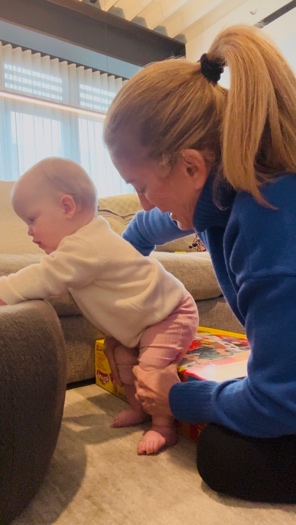
“Should my baby be doing this by now?” is one of the most common questions parents ask me.
Maybe your baby isn't rolling yet. Sitting may be difficult, crawling hasn't started, or your baby may be interested in standing but have trouble getting there independently. Sometimes a baby is technically reaching milestones, but you notice that the movement looks different from what you expected. Development doesn't follow an exact calendar. Babies reach skills within a range, and when a milestone happens is only one part of the developmental picture. Through Motor Skills Matter, I provide individualized, in-home pediatric physical therapy evaluations for babies with developmental concerns throughout NYC and the Hamptons. I don't look only at whether your baby is early or late. I want to understand how your baby is learning to move.
What Is a Motor Developmental Delay?
A motor developmental delay occurs when a baby or child is slower than expected to acquire physical skills such as head control, rolling, sitting, crawling, standing, or walking. But development is more nuanced than checking a milestone off a list. Your baby may achieve a skill but use a movement strategy that makes the skill harder or less efficient. A baby may roll only toward one side, sit independently but be unable to get into or out of sitting, move across the floor using the two sides of the body differently, or consistently pull to stand through the same leg. I may also see a baby who relies heavily on the arms in standing, consistently stands on the toes, avoids certain positions, or has difficulty moving from one position to another. This is why I consider both milestone acquisition and movement quality.
Your Baby Is Not a Checklist
Developmental milestone charts are useful reference points, but they can't show me exactly how your individual baby moves. I look at strength, muscle tone, symmetry, postural control, balance, coordination, weight shifting, rotation, and movement variety. I also pay attention to how easily your baby moves between positions, whether both sides of the body are being used, how much effort a movement requires, and what your baby does when a movement becomes challenging. Sometimes what your baby isn't doing is important. Other times, what catches my attention is how your baby is doing it.
My Baby Isn’t Rolling Yet
I don't evaluate rolling as an isolated skill. Before your baby rolls independently, I look at the movements that help make rolling possible. I want to see whether your baby can comfortably turn the head in both directions, bring the hands toward the middle of the body, reach across midline, rotate through the trunk, and shift weight from side to side. I also look at tummy time and whether your baby is beginning to initiate movement rather than remaining mostly in the position where they were placed. A baby who isn't rolling may simply need more opportunities to practice. Another baby may have torticollis, body tension, weakness, limited rotation, low muscle tone, or another factor that is making rolling more difficult. Understanding why the skill hasn't emerged helps me decide what, if anything, your baby needs next.
My Baby Isn’t Sitting Yet
Independent sitting involves much more than having enough strength to stay upright. Your baby needs trunk control, balance reactions, the ability to shift weight, and enough movement variety to adjust when balance begins to change. I also look at what happens around sitting. Can your baby reach for toys in different directions, rotate through the trunk, or place a hand down for support? Can they begin moving from sitting toward the floor and eventually learn to get into and out of sitting independently? A baby who can sit when placed there has achieved an important skill. I also want sitting to become a functional part of play rather than a position your baby can only maintain once someone else puts them there.
What About Crawling?
Babies vary in how they move across the floor, and not every baby follows exactly the same developmental sequence. I don't focus on crawling simply because it is a box that needs to be checked. Floor mobility gives your baby opportunities for weight bearing through the arms and legs, trunk rotation, coordination between the two sides of the body, weight shifting, strength, and independent exploration. If your baby isn't crawling, I look at why floor mobility may be difficult or avoided. I want to know whether your baby can move into and out of sitting, tolerate weight through the hands, get onto hands and knees, shift weight, rotate and reach, and use both sides of the body. Those movement skills often tell me more than whether crawling has happened yet.
My Baby Isn’t Walking Yet
Walking has a broad developmental range. Some babies walk relatively early, while others spend more time crawling, cruising, and developing balance before taking independent steps. Walking earlier is not necessarily better. Before independent walking, I look at how your baby pulls to stand, stands with decreasing support, cruises in both directions, shifts weight between the feet, squats and returns to standing, and moves between support surfaces. I also look at standing balance, controlled lowering to the floor, and whether your baby is gradually able to take steps with less assistance. I don't want to rush your baby into walking. I want your baby to develop the strength, balance, coordination, and confidence that support independent walking.
Sometimes the Concern Is Not Delay, It’s Asymmetry
One of the things I pay close attention to is a consistent difference between the two sides of your baby's body. You may notice that your baby always rolls toward the same side, consistently reaches with one hand, turns the head predominantly in one direction, pushes more strongly through one leg, or always transitions through the same side. Some babies drag one side while moving across the floor or consistently use one leg differently in standing. Babies naturally experiment with movement, so an occasional difference between the two sides doesn't automatically indicate a problem. What interests me more is a persistent preference that becomes your baby's primary way of moving. During the first year, I generally want to see your baby developing a variety of movement options rather than relying almost exclusively on one strategy.
Why Movement Compensations Matter
Babies are very good at finding ways to get where they want to go. If a movement is difficult, they often discover another strategy that works. That adaptability is a normal part of development. The concern is when one compensatory strategy becomes the main way your baby moves and there are fewer opportunities to develop other movement patterns. For example, a baby who has difficulty rotating through the trunk may begin moving the body as one unit. A baby with limited weight shifting may find another way to transition, while a baby with weakness may rely heavily on the arms when standing. My goal isn't to make every movement look exactly the same. I want your baby to develop a broader variety of movement options so there is more than one way to solve a movement challenge.
Factors That Can Contribute to Delayed Motor Development
There isn't one cause of motor delay. Sometimes the reason is clear, and sometimes a baby has no obvious medical diagnosis. Prematurity, low muscle tone, weakness, torticollis, movement asymmetry, increased body tension, joint laxity, orthopedic differences, neurological conditions, medical complexity, extended hospitalization, limited opportunities for floor movement, and sensory or movement sensitivities can all influence motor development. This is why I evaluate your individual baby rather than assuming that the same explanation applies to every developmental delay.
Prematurity and Corrected Age
If your baby was born prematurely, I don't compare development with that of a full-term baby using chronological age alone. Corrected age is generally considered when looking at early developmental milestones in premature infants. Corrected age doesn't answer every developmental question, however. I also look at movement quality, muscle tone, symmetry, strength, postural control, and how your baby's skills are progressing over time. Sometimes a premature baby is developing appropriately for corrected age but would still benefit from support for a specific movement pattern. In other cases, a parent may be worried about a milestone that is completely appropriate once corrected age is considered. An evaluation may lead to treatment, but sometimes it simply provides reassurance and guidance.
Baby Equipment and Opportunities to Move
Swings, bouncers, activity seats, jumpers, and other baby equipment can be convenient. I understand that parents need practical and safe places for their babies throughout the day. I also want your baby to have plenty of opportunities to move freely. Floor play allows babies to reach, roll, push, pivot, shift weight, lose balance, adjust, and try again. Those everyday experiences give babies opportunities to practice emerging skills. During an evaluation, I can look at the equipment you use and help you decide what is appropriate for your baby's current developmental stage, what may be better used for shorter periods, and where unrestricted movement can realistically fit into the day. I am not looking for perfection or asking you to eliminate every baby product. I want to find a reasonable balance between supported positioning and active movement.
What Does a Developmental Physical Therapy Evaluation Include?
I start with your concerns. I also review relevant pregnancy, birth, and medical history and spend time watching how your baby naturally moves during play. Depending on your baby's age, I may assess muscle tone, strength, range of motion, postural control, movement symmetry, head and trunk control, weight shifting, rotation, balance, and righting reactions. I also observe age-appropriate skills such as tummy time, rolling, sitting, transitions, floor mobility, crawling, kneeling, pulling to stand, cruising, standing, and emerging gait. Throughout the evaluation, I pay attention to the overall quality and variety of your baby's movement, not just whether a skill is present. When appropriate, I may use standardized developmental measures along with clinical observation. Standardized testing can tell me where your baby's skills fall in relation to expected development. Observation gives me another important piece of information: how your baby is accomplishing those skills. I use both perspectives when they are appropriate.
What Happens After the Evaluation?
Not every baby I evaluate needs ongoing physical therapy. If your baby's movement appears appropriate, I may reassure you, suggest a few activities or positioning changes, and recommend that you continue to monitor development. If I identify a specific area that would benefit from intervention, I develop an individualized plan based on what your baby needs. Treatment may address strength, postural control, movement symmetry, weight shifting, rotation, balance, transitions, floor mobility, standing, walking, or confidence with movement. I also give you practical ideas that can fit into your everyday routines rather than an overwhelming exercise program.
When Should I Ask for Help?
You don't need to wait until your baby is significantly behind before asking someone to take a closer look. I would consider discussing your concerns with your pediatrician or seeking a pediatric physical therapy evaluation if your baby consistently uses one side differently, has difficulty with tummy time, seems unusually stiff or floppy, or isn't progressing toward an expected skill. I would also pay attention if movement seems unusually effortful, your baby appears stuck at one developmental stage, or you are concerned about the quality of your baby's movement. If your baby loses a developmental skill they previously had, discuss that promptly with your child's healthcare provider. You know what you see throughout your baby's day. If the same movement difference keeps catching your attention, it is reasonable to ask about it.
In-Home Pediatric Physical Therapy in NYC & the Hamptons
Seeing your baby at home allows me to observe movement in a familiar environment. I can also look at the spaces and routines that are part of your baby's actual day, including floor play, toys, seating, feeding positions, and infant equipment. That helps me make recommendations that fit both your baby's developmental needs and your family's everyday life. Through Motor Skills Matter, I provide in-home infant and pediatric physical therapy throughout NYC and the Hamptons.
Why Choose Motor Skills Matter?
I am Dr. Tara Liddle, PT, MA, DPT, PCS, a Board-Certified Pediatric Clinical Specialist with more than 30 years of experience working with babies and children. My career includes extensive work with newborns, premature infants, neonatal developmental follow-up, pediatric rehabilitation, and children with developmental and neurological conditions. I am NDT certified and have advanced training in pediatric movement and neuromuscular treatment. I am the author of Why Motor Skills Matter: Improve Your Child’s Physical Development to Enhance Learning and Self-Esteem and a contributing author of the chapter “Physical Therapist Management of Cerebral Palsy” in Contemporary and Global Perspectives in Physical Therapy: Incorporating Clinical Practice Guidelines, published by Springer Nature. My approach looks beyond whether your baby has reached a milestone. I pay close attention to the quality, symmetry, and variety of movement and how your baby is learning to move.
Frequently Asked Questions About Baby Motor Development
- Should I worry if my baby is late reaching one milestone?
- Not necessarily. Development occurs across a range, and one later milestone by itself doesn't mean your baby has a developmental problem. I look at your baby's overall progression, movement quality, and whether new skills are continuing to emerge. That gives me much more information than one milestone or one date on a developmental chart.
- Is it a problem if my baby skips crawling?
- Not every baby follows exactly the same developmental sequence. Rather than focusing only on whether your baby crawls, I look at the movement skills surrounding floor mobility. I want to see opportunities for weight bearing, rotation, coordination, transitions, weight shifting, and use of both sides of the body.
- My baby can sit when I put them there. Does that count as sitting?
- Yes, maintaining sitting is an important skill. I also look at what your baby can do once sitting. Can your baby reach and rotate without immediately losing balance? Can they move toward the floor and eventually learn to get into and out of sitting independently? I want sitting to become part of functional, independent movement rather than only a position your baby can maintain after being placed there.
- Is early walking a sign of advanced development?
- Not necessarily. The age when your baby begins walking tells me only one part of their motor development. I am also interested in balance, coordination, strength, movement variety, and the skills your baby develops before and around independent walking.
- Should I compare my baby with other babies the same age?
- Seeing other babies can certainly make developmental differences more noticeable, but comparison alone isn't a reliable developmental assessment. There is a normal range in when and how babies develop skills. If you are concerned, I would rather look closely at your baby's individual movement and progression.
- What if everyone tells me to “wait and see”?
- Sometimes waiting and monitoring are completely appropriate. An evaluation doesn't automatically mean your baby needs physical therapy. If you have a persistent concern, I can assess your baby's development and help determine whether everything looks appropriate, whether a few strategies may help, or whether intervention would be useful.
Wondering Whether Your Baby’s Development Is on Track?
You don't need to know what the problem is before contacting me. Maybe your baby isn't rolling, sitting, crawling, or walking when you expected. Perhaps one side seems different from the other, or your baby is reaching milestones but something about the movement doesn't look quite right. I can evaluate how your baby is moving, help you understand what you are seeing, and determine whether your baby would benefit from support or simply needs more time. Through Motor Skills Matter, I provide expert in-home pediatric physical therapy and developmental evaluations in NYC and the Hamptons.