
Baby Seats, Bouncers, Jumpers, Activity Centers & Floor Play
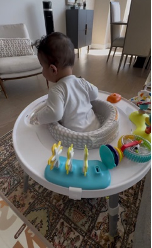
Baby equipment is everywhere. Car seats, strollers, bouncers, swings, floor seats, activity centers, jumpers, highchairs, push toys, and walkers fill baby registries and store shelves. Some are necessary, some are convenient, and many are marketed as helping your baby learn or develop. Parents often ask me, “Is this good for my baby's development?” I rarely answer by simply labeling a product good or bad. Instead, I look at what your baby is able to do while using it, how much support the equipment provides, how long your baby spends there, and what opportunities for independent movement may be replaced. Equipment can have a place in family life. I just don't want it to become the place where most of your baby's movement happens.
Babies Learn to Move by Moving
Babies develop motor skills through experience. Your baby learns to lift the head by working against gravity, roll by shifting weight and experimenting with movement, sit by learning to balance, and crawl by figuring out how to move across the floor. Later, standing and walking develop through pulling up, shifting weight, losing balance, adjusting, and trying again. No piece of baby equipment can replace those experiences. Equipment provides support. Motor development gradually requires your baby to provide more of that support independently. That is why safe, supervised floor time remains one of the most valuable environments for early motor development.
What Pediatric Physical Therapists Mean by “Containers”
In pediatric therapy, the word “container” is often used to describe equipment that supports or positions a baby while limiting some freedom of movement. Car seats, strollers, swings, bouncers, infant loungers, molded floor seats, highchairs, activity centers, jumpers, and seated walkers may all fall into this broad category, although they serve very different purposes. Calling something a container doesn't mean it is automatically harmful. A car seat is essential for safe transportation. A highchair provides an appropriate place for feeding. A stroller allows families to get out of the house. A bouncer may give you a safe place for your baby while you shower or prepare a meal. I am not interested in making parents feel guilty for using baby equipment. I want to make sure your baby still has plenty of opportunities to move independently.
The Issue Is Often Cumulative Time
It is easy for equipment time to add up without realizing it. Your baby may spend time in the car seat, then the stroller, then a bouncer while you make breakfast, followed later by an activity seat and another car ride. None of those periods may seem particularly long on its own. By the end of the day, however, the amount of unrestricted movement time may be much shorter than you expected. Rather than asking you to monitor every minute with a stopwatch, I prefer to look at the whole day. How much time did your baby have to move freely on the back, tummy, and sides and, as development progresses, to sit, transition, crawl, kneel, stand, and explore? That balance matters more to me than one isolated period in a piece of equipment.
Why Floor Time Is So Valuable
On the floor, your baby has something equipment cannot fully provide: freedom to experiment. On the back, your baby can kick, reach, bring the hands together, lift the legs, turn the head, and begin rolling toward the side. During tummy time, your baby can lift and turn the head, push through the arms, shift weight, reach, pivot, and eventually begin moving across the floor. The floor doesn't teach milestones. It gives your baby the space to discover them. As your baby gets older, that same floor becomes the place to practice rolling, sitting, transitions, crawling, kneeling, and eventually moving toward standing.
Car Seats: Essential for Travel, Not a Play Space
Car seats save lives and should always be used correctly for transportation. My developmental concern isn't appropriate car-seat use. It is unnecessary time spent in the seat once transportation has ended. While strapped into a car seat, your baby isn't able to practice rolling, tummy time, unrestricted reaching, or many of the other movements that happen on the floor. This can be particularly relevant for a baby with torticollis, a persistent head-turning preference, plagiocephaly, low muscle tone, prematurity, or delayed motor development. The answer isn't to avoid the car seat when it is needed. Once the trip is over, I simply like babies to have opportunities to come out, change position, and move.
Safe Sleep Comes First
Sleep safety always takes priority over developmental positioning. If your baby falls asleep in a car seat, stroller, swing, carrier, or sling, follow current safe-sleep recommendations about moving your baby to an appropriate firm, flat sleep surface on the back as soon as practical. Products that aren't designed and approved for infant sleep shouldn't become routine sleep spaces. When I discuss equipment with families, I separate awake developmental positioning from safe sleep. They are different issues, and sleep safety comes first.
Bouncers and Swings
Bouncers and swings can be useful, and many babies enjoy them. Parents may need them too. The developmental question is what the rest of your baby's day looks like. A young baby who spends a significant amount of awake time reclined in supportive equipment has fewer opportunities to work against gravity independently. I pay particular attention to equipment use when a baby is having difficulty with tummy time, head control, rolling, low muscle tone, a persistent head preference, or head-shape concerns. Sometimes a simple shift toward more frequent floor opportunities can make a meaningful difference.
Floor Seats and Learning to Sit
Parents often buy a floor seat because their baby wants to be upright but can't yet sit independently. A seat can provide temporary support, but being supported in sitting isn't the same as learning to sit. Independent sitting requires your baby to control the trunk, shift weight, use the arms for support when needed, respond to a loss of balance, rotate, and reach outside the base of support. If the seat provides most of that stability, your baby doesn't practice those components in the same way. That doesn't mean a floor seat can never be used. I simply don't want supported sitting to replace the movement experiences that eventually allow your baby to sit independently.
When Your Baby Loves Sitting Up
Many babies love being upright because they can see more of what is happening around them. Enjoying the position, however, doesn't always mean your baby is developmentally ready to control it independently for long periods. Depending on your baby's age, carrying, supported sitting with your hands, side sitting, tummy time, reaching, rolling, and other floor play can provide opportunities to interact with the world while still developing the strength and control needed for independent sitting. Your baby's interest in a position and ability to control that position aren't always the same thing.
Activity Centers
Stationary activity centers allow babies to remain upright while interacting with toys and moving within a limited space. Many babies love them. When I look at an activity center, I consider your baby's age, head and trunk control, foot position, alignment, how much weight is going through the feet, whether your baby is leaning heavily or standing on the toes, and how much time is spent there. I also want to know what your baby is doing during the rest of the day. Being supported upright in an activity center is a very different motor experience from pulling to stand and balancing at furniture independently.
Jumpers
Jumpers are appealing because babies often look delighted while bouncing. But bouncing isn't the same as learning to stand or walk. A jumper provides external support while your baby repeatedly pushes against a surface. For a baby who already strongly prefers straightening the body or standing on the toes, that may provide many repetitions of a movement pattern I am trying to balance with other experiences. I am particularly cautious when I see persistent toe standing, strong leg extension, limited floor mobility, difficulty with transitions, calf tightness, or a baby who wants to be upright but has limited trunk control. The jumper may not have caused the pattern. I simply don't want your baby practicing the same pattern hundreds of additional times if other movement experiences are needed.
Seated Baby Walkers With Wheels
This is one category where my recommendation is much clearer: I do not recommend mobile seated baby walkers. These walkers don't teach the balance, weight shifting, transitions, and postural control required for independent walking. They also present important safety concerns because babies can move quickly and reach hazards while supported inside them. A seated mobile walker is very different from a push toy. With a push toy, a developmentally ready baby stands behind the toy, bears weight through the legs, and actively controls the body while stepping.
Push Toys Are Different From Seated Walkers
A stable push toy can sometimes be useful when your baby is already pulling to stand, cruising, bearing weight through the legs, and beginning to take steps with support. Your baby stands behind the toy and actively moves it forward. The quality of the toy matters, however. If it rolls too quickly, your baby may lean forward and chase it rather than control each step. I prefer a stable push toy that moves at a manageable speed. Even then, a push toy is only one movement experience. Your baby still needs opportunities to stand, cruise, squat, shift weight, and balance without relying on it.
Highchairs
A highchair is primarily for feeding, and appropriate positioning can make mealtime much easier for your baby. I like to see the trunk supported appropriately, the pelvis stable, the body reasonably upright, and the feet supported when possible. Good positioning can allow your child to focus on eating rather than using excessive effort simply to remain upright. A highchair doesn't replace floor-based sitting or movement practice. Feeding time is feeding time. Your baby needs other opportunities to develop independent motor skills.
Baby Carriers
Baby carriers are another reason I don't like describing equipment as simply good or bad. A well-fitted, age-appropriate carrier can be very useful. It provides closeness, transportation, and a different sensory experience for your baby. Being carried, however, isn't the same developmental experience as moving independently on the floor. Both can have a place in the day. Proper positioning, developmental readiness, and following the manufacturer's safety guidance are important.
Do Containers Cause Flat Head Syndrome?
Prolonged pressure on one area of the skull can contribute to positional head-shape changes, particularly when a baby also has a head-turning preference or limited active movement. Equipment that supports the back of the head may add to the cumulative time your baby spends in the same position. I wouldn't tell a family that one swing or bouncer “caused” plagiocephaly. Head shape can be influenced by several factors, including prenatal positioning, prematurity, torticollis, a head-turning preference, movement asymmetry, repeated positioning, and the amount of independent movement your baby has throughout the day. When I evaluate plagiocephaly, equipment use is one piece of a much larger picture.
Equipment and Torticollis
A baby with torticollis may repeatedly turn toward the preferred side when placed in supportive equipment. If the same thing happens in the car seat, stroller, bouncer, and activity seat, your baby may spend a considerable amount of time repeating one position. Sometimes changing where equipment is placed in the room, where toys are positioned, or how your baby is carried can encourage movement toward the other side. Those changes can be useful, but they don't replace appropriate treatment when torticollis is present.
Equipment and Tummy Time
Equipment and tummy time can sometimes become part of a cycle. A baby who spends a lot of time supported may find tummy time difficult. When the baby cries on the floor, the parent understandably returns the baby to a comfortable seat. The baby then gets fewer opportunities to build the strength and control that may eventually make tummy time easier. This isn't about blaming parents. It is about recognizing the pattern and changing it gradually. For many babies, several short and successful floor opportunities throughout the day work much better than suddenly eliminating equipment and expecting one long tummy-time session.
Equipment and Body Tension
For a baby who already strongly prefers extension, certain upright devices may make it easy to repeatedly push through the legs. That can look impressive because the baby appears strong and may love being upright. But I also want to see your baby developing rotation, bending, weight shifting, side-to-side control, transitions, and independent floor mobility. Babies need more than one movement strategy.
Equipment and Low Muscle Tone
Babies with low muscle tone may appear to need supportive equipment because maintaining posture independently requires more effort. Sometimes support is useful. The challenge is finding the right amount. I want your baby to have enough support to be successful without having the equipment do all of the postural work. This is particularly important when considering equipment for sitting and standing.
Do Babies Need Equipment to Learn Motor Skills?
For most typically developing babies, early motor development requires surprisingly little equipment. A safe floor space, a few interesting toys, and an engaged caregiver can provide a tremendous amount of developmental opportunity. The baby-product market can make it seem as though every stage requires another device. It doesn’t. Equipment may offer convenience, support, transportation, or entertainment. Babies develop movement primarily by interacting with their own bodies, the people around them, and their environment.
Is There a “Right” Amount of Container Time?
Parents often ask me for a specific number. I prefer not to turn parenting into a stopwatch exercise. Different equipment serves different purposes, and your baby's entire day matters more than one isolated period. Instead, I would ask: How much opportunity did my baby have to move freely today? If your baby spent much of the morning in the car, stroller, and bouncer, the afternoon may be a good opportunity for more floor play. If you need the bouncer while you shower, use it safely and appropriately, then give your baby another opportunity to move afterward. The goal isn't perfection. It is balance.
The 15- or 20-Minute “Container Rule”
You may hear that babies should never spend more than 15 or 20 minutes at a time in a container. I would rather you understand the reason behind that advice than become anxious about crossing an exact minute threshold. A safe car trip may last longer because your baby needs to be in the car seat. A highchair is being used for a meal. Those situations are different from leaving a baby in supportive equipment for extended periods simply because it is convenient. The principle is to avoid unnecessary prolonged awake time in equipment when your baby could safely be moving elsewhere.
How to Know Whether Your Baby Is Ready for Equipment
The age printed on the box is only part of the decision. Manufacturer age, height, and weight requirements are important for safety. Developmental readiness matters too. I look at your baby's head and trunk control, sitting ability, strength, alignment, foot contact, and how much support the product provides. I also want to see what your baby actually does once placed in it. A baby may technically meet the manufacturer's age or size requirements and still not have the motor control to use a particular product well.
When to Stop Using a Product
Babies change quickly. Equipment that was useful a month ago may no longer offer much benefit. Sometimes your baby physically outgrows a product. Other times, your baby developmentally outgrows it. As independent sitting develops, a floor seat may become less useful. Once your baby becomes mobile, a safe gated floor space may provide far more opportunity than an activity center. I like to periodically ask whether a product is still helping your baby or whether your baby is ready for an experience that requires more independent movement.
You Don’t Need a House Full of Baby Equipment
I often tell families that they don't need to buy every product marketed for development. Before buying something, I think about what it will allow your baby to do, whether your baby already has another way to practice that skill, how long the product will realistically be useful, and whether it creates opportunities for movement or restricts them. Sometimes the answer is simply that the product will make your life easier. That is a legitimate reason too. Parents need to shower, cook, make a phone call, spend time with another child, and get through the day. My goal isn't a baby who is never placed in equipment. It is a baby who still has plenty of opportunities to move freely.
How I Review Baby Equipment During an Evaluation
When equipment is relevant to your baby's development, I may ask you to show me what you are using. I look at how your baby is positioned, whether the equipment fits properly, whether your baby is developmentally ready for it, what movement happens while your baby is there, and how frequently it is being used. Sometimes I recommend a small positioning adjustment. I may suggest using something for shorter periods, waiting until your baby has more motor control, or choosing a different option. The recommendation depends on your baby, not simply on the product.
Creating a Movement-Friendly Home
You don't need a therapy gym to support your baby's development. A clean, firm floor or mat, a few interesting toys, and enough space to turn, reach, roll, and eventually move can be enough. As your baby develops, the environment can change too. Safe furniture may eventually become an opportunity to kneel, pull to stand, cruise, and move between surfaces. A three-month-old needs a very different movement environment from a ten-month-old who is trying to climb onto the couch.
What If My Baby Hates the Floor?
Some babies become very accustomed to being supported. When they are placed on the floor, movement suddenly requires much more effort. That doesn't necessarily mean the floor is inappropriate. It may simply be difficult. Start with shorter periods. Get down on the floor with your baby, use a favorite toy, and change positions rather than expecting one long stretch of floor play. If your baby remains extremely uncomfortable on the floor, struggles significantly with tummy time, seems unusually stiff or floppy, or isn't progressing with motor development, an evaluation may help me understand why.
In-Home Baby Equipment & Developmental Consultation
One advantage of seeing your baby at home is that I can look at the equipment exactly where it is being used. You don't have to remember the brand or try to explain how a particular seat fits. We can look at it together. I can also see where your baby plays and how equipment fits into the normal rhythm of the day. That allows me to make practical recommendations using the space and products you already have. Through Motor Skills Matter, I provide in-home pediatric physical therapy, Baby Wellness & Developmental Checkups, and guidance on baby equipment and motor development throughout NYC and the Hamptons.
Why Choose Motor Skills Matter?
I am Dr. Tara Liddle, PT, MA, DPT, PCS, a Board-Certified Pediatric Clinical Specialist with more than 30 years of experience working with babies and children. My background includes 19 years in NICU and neonatal developmental follow-up, along with extensive experience in infant motor development, torticollis, plagiocephaly, hypotonia, prematurity, and developmental delay. I am NDT certified and have advanced training in pediatric movement and neuromuscular treatment. I am the author of Why Motor Skills Matter: Improve Your Child's Physical Development to Enhance Learning and Self-Esteem and a contributing author of the chapter “Physical Therapist Management of Cerebral Palsy” in Contemporary and Global Perspectives in Physical Therapy: Incorporating Clinical Practice Guidelines, published by Springer Nature. My approach isn't about creating more rules for parents. I want to help you understand what your baby needs for movement and how everyday choices can create more opportunities for development.
Frequently Asked Questions About Baby Equipment
- Are all baby containers bad?
- No. Different products serve different purposes. Car seats are essential for safe travel, highchairs are useful for feeding, and other equipment can provide convenience or temporary support. I am more concerned when unnecessary or prolonged equipment use consistently replaces opportunities for independent movement.
- How long can my baby stay in a bouncer?
- I don't use one exact number for every baby and every product. I generally prefer awake time in supportive equipment to be balanced with frequent opportunities for your baby to move freely. Your baby's age, development, the type of equipment, and the rest of the day all matter.
- Are activity centers bad for babies?
- Not automatically. I consider your baby's developmental readiness, positioning, foot contact, alignment, how the equipment is being used, and what other movement opportunities your baby has throughout the day.
- Are jumpers good for leg strength?
- Jumpers allow babies to repeatedly push through the legs, but pushing isn't the same as developing the balance, postural control, weight shifting, and transitions needed for standing and walking. I am particularly cautious with jumpers for babies who already demonstrate persistent toe standing or strong extension patterns.
- Will a baby walker teach my baby to walk?
- No. A seated mobile walker doesn't teach the balance and postural control needed for independent walking and carries significant safety concerns. I don't recommend seated mobile baby walkers.
- Is a push walker the same as a seated baby walker?
- No. They are very different. With a push toy, your baby stands behind the toy and actively takes steps while pushing it. A seated walker supports your baby's body inside a wheeled frame.
- Should my baby use a floor seat before sitting independently?
- A supported seat may have a place for brief, appropriate use, but sitting in a seat isn't the same as developing independent sitting balance. Your baby still needs opportunities to work on trunk control, weight shifting, reaching, rotation, and balance through active movement.
- Does my baby need an activity center?
- No. An activity center may be entertaining or convenient, but your baby doesn't need one to develop motor skills.
- Can equipment cause plagiocephaly?
- Head shape is influenced by multiple factors. Prolonged time in equipment that repeatedly places pressure on the same part of the skull may contribute, particularly when a baby also has torticollis or a strong head preference. I consider equipment use as one part of the overall picture.
- What equipment is best for my baby’s development?
- Often, some of the most useful things are the simplest: a safe place on the floor, a few toys, and enough freedom to move. The best choices also depend on your baby's age, motor abilities, and individual needs.
Containers Change Movement
Containers change movement because the environment influences what your baby gets to practice. Place your baby in a supportive seat and your baby practices moving within that support. Give the same baby a safe space on the floor and your baby has the opportunity to practice controlling the body more independently. Both experiences may have a place in family life. You don't need to eliminate every bouncer, stroller, seat, or carrier. You don't need to feel guilty about putting your baby somewhere safe while you make dinner. And you certainly don't need to buy every product marketed as developmental. Babies need something much simpler: time, space, interaction, and opportunities to move. If you are unsure whether a piece of equipment is appropriate for your baby's age or development, I can look at how your baby uses it and help you decide what makes sense.
Contact me to schedule a Baby Wellness & Developmental Checkup or infant physical therapy evaluation.