
When Your Baby Seems Stiff, Tense or Frequently Arches Backward
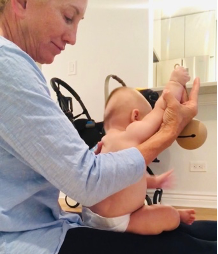
“My baby seems really strong.” “My baby's body is always tense.” “She arches backward every time I pick her up.” “His legs are always stiff.”
I hear comments like these frequently from parents. Babies naturally stiffen, stretch, push, and arch at different times. Brief extension while stretching, crying, or changing position can be part of typical movement. When your baby is consistently stiff, frequently arches backward, or relies heavily on extension to move, I look more closely at the overall movement pattern. I want to understand what your baby is doing, when it happens, and whether that pattern is making other ways of moving more difficult.
What Does Body Tension Look Like in a Baby?
Body tension can look different from one baby to another. You may notice frequent back arching, the head being thrown backward, very straight legs, or stiffening when you pick your baby up. Some babies push strongly through their feet, resist being curled forward, or seem uncomfortable in certain positions. You may also notice that your baby rolls by arching backward, looks tense during tummy time, has difficulty bringing the hands toward midline, or strongly prefers looking and moving toward one side. Some babies tend to move the body as one unit rather than rotating through the trunk. One of these observations by itself doesn't necessarily mean there is a problem. I pay more attention when the same movement strategy appears repeatedly across different positions and activities.
Is My Baby Stiff or Just Strong?
A baby who pushes forcefully through the legs or lifts the head very high may look remarkably strong. But strength and stiffness aren't the same. Strength involves generating force with control. Motor development also requires your baby to relax, bend, rotate, shift weight, move in and out of positions, and use different movement strategies. I don't evaluate strength only by looking at how hard your baby can push. I also want to see how many different ways your baby can move.
What Is Extension-Dominant Movement?
Extension refers to movements that straighten or lengthen the body. Your baby needs extension to lift the head during tummy time, push through the arms, stand, and eventually walk. I become more interested when extension is the strategy your baby uses for almost everything. You may see your baby throw the head backward, arch through the trunk, straighten the legs, pull the shoulders backward, or push forcefully through the feet. Your baby also needs to learn to bring the hands together and toward the mouth, look down, reach toward the feet, bend the hips and knees, rotate through the trunk, and shift weight from side to side. I don't want to eliminate extension. I want your baby to have other movement choices as well.
Why Does My Baby Arch Backward?
Babies arch for many reasons. Your baby may briefly arch while stretching, crying, becoming frustrated or tired, responding to stimulation, or changing position. Some babies arch during or after feeding because they are uncomfortable. For others, arching appears across many different activities and becomes part of a broader movement pattern. I look at when and how often your baby arches. I want to know whether it happens primarily during feeding, tummy time, carrying, rolling, or sitting, whether your baby can easily relax afterward, and whether arching is interfering with other movement. Context matters much more than one isolated episode.
Arching During or After Feeding
If your baby arches primarily during or after feeding, discomfort may be contributing. Reflux or other feeding-related concerns can sometimes be associated with back arching. If you are also seeing feeding refusal, significant distress, choking, gagging, swallowing difficulty, poor weight gain, or persistent vomiting, I recommend discussing those symptoms with your baby's pediatrician and, when appropriate, the feeding team. I can help with positioning and motor development, but physical therapy doesn't diagnose or treat medical causes of feeding-related discomfort.
Muscle Tone, Stiffness and Strength Are Different
Parents often hear tone, tightness, stiffness, and strength used as though they mean the same thing. They don’t. Muscle tone refers to the background level of tension or activity in the muscles. Strength refers to the ability to generate force. A baby can have good strength and still appear stiff, and a baby with lower muscle tone may sometimes use stiffening as a way to create stability. This is one reason I don't try to determine what is happening from one movement or a short video. I look at how your baby moves across several positions and activities.
Does a Stiff Baby Have High Muscle Tone?
Not necessarily. I would not automatically label a baby who feels stiff or frequently arches as having hypertonia. I consider spontaneous movement, posture, range of motion, reflexes, strength, symmetry, developmental progression, and medical history. I also look at whether your baby can move in and out of the stiff pattern rather than simply whether stiffness is present. If I see findings that raise concern about muscle tone or neurological development, I may recommend further evaluation with your baby's pediatrician or another specialist.
Early Head Control Isn’t Always the Same as Good Head Control
It is exciting to see a very young baby lift the head high. Sometimes, however, a very early high head position reflects strong extension through the neck and trunk rather than mature postural control. I look at much more than how high your baby can lift the head. Can your baby comfortably turn toward both sides, lower the head with control, bear weight through the forearms, keep the shoulders from pulling backward, and begin shifting weight? Earlier isn't always better. How your baby controls the movement matters.
What If My Baby Rolled Very Early?
Some babies roll surprisingly early. Sometimes the movement is intentional, while at other times gravity, head position, or strong arching helps carry the body over. I look at how the roll happened. Did your baby shift weight, rotate through the trunk, and move the head and body in a controlled sequence? Is your baby beginning to roll toward both sides? A baby who becomes stiff, throws the head backward, and tips over has technically changed position, but that movement is different from a controlled roll that develops through weight shifting and rotation.
Body Tension and Tummy Time
Tummy time gives me a useful opportunity to see how your baby uses extension. A baby with a strong extension preference may lift the head very high while arching through the trunk, pulling the arms backward, and keeping the legs straight. Your baby may have difficulty bearing weight through the forearms, reaching, or shifting weight even though the head appears impressively high. My goal isn't simply to get your baby's head higher. I want your baby to learn to use the head, arms, and trunk together with increasing control.
Body Tension and Torticollis
Body tension can occur along with torticollis or a strong head-turning preference. If your baby repeatedly turns toward one side, the pattern may gradually involve more than the neck. I may see differences in shoulder position, trunk rotation, weight shifting, reaching, rolling, or how the arms are being used. This is why I look at your baby's whole movement pattern when I evaluate torticollis rather than focusing only on neck range of motion.
Body Tension and Head Shape
If your baby strongly prefers one position, pressure may repeatedly occur on the same area of the skull and contribute to head-shape asymmetry. When I see plagiocephaly or another head-shape concern, I also look at neck movement, head preference, body tension, tummy time, movement symmetry, positioning, and equipment use. I want to understand why your baby's head keeps returning to the same position, not simply observe the shape of the skull.
Why Does My Baby Push Through the Legs So Much?
Parents sometimes tell me, “My baby wants to stand all the time.” A young baby may push very strongly through the legs when held upright, but that doesn't necessarily mean the baby is developmentally ready to stand. Early pushing may reflect spontaneous or reflexive weight bearing or simply your baby's individual movement pattern. As standing develops, it requires much more than straightening the legs. I look for trunk control, hip stability, balance, weight shifting, foot and ankle control, and the ability to bend as well as straighten the legs. A baby who pushes strongly into extension can look advanced while still needing opportunities to develop the movement skills that support independent standing.
Does My Baby Need to Stop Standing?
Not necessarily. Babies can bear weight through their legs, and many enjoy being upright. I become more interested when standing is your baby's overwhelming preference and begins replacing other movement experiences. Your baby still needs opportunities to play on the floor, roll, reach, rotate, sit, transition, and explore different positions. Standing is one part of development. It doesn't need to replace the skills that come before independent standing and walking.
Baby Equipment and Body Tension
Some babies with strong extension preferences love upright equipment because it allows them to push forcefully through the legs. Activity centers and other supported devices don't automatically cause body tension, but I do look at what your baby repeatedly practices while using them. If your baby already spends a great deal of time arching, straightening the legs, pushing through the toes, or holding the body rigidly, I may recommend reducing equipment that encourages more of the same pattern. Instead, I may suggest more opportunities for varied floor movement where your baby can bend, rotate, shift weight, reach, and change positions.
What About Babies With Low Muscle Tone Who Stiffen?
This can be confusing because a baby with low muscle tone may sometimes look quite stiff. If controlling the body in the middle of the movement range is difficult, your baby may lock or stiffen the body to create stability. That can make a position feel more secure. This is another reason I don't assume that a baby who looks stiff has high muscle tone. I look at the entire movement pattern.
Body Tension in Premature Babies
Premature babies can show a variety of early movement and postural patterns. A history that includes NICU care, medical procedures, respiratory support, feeding challenges, and different early sensory and movement experiences can all provide useful context. Corrected age matters, but it isn't the only thing I consider. I also pay close attention to movement quality, symmetry, muscle tone, and developmental progression. If your premature baby is persistently stiff, strongly extends, or has difficulty moving in a variety of ways, a developmental evaluation may help clarify what you are seeing.
When Is Stiffness More Concerning?
Some stiffness and arching can occur during typical development. I pay closer attention when the pattern is persistent, strong, increasing, clearly different between the two sides, or beginning to interfere with movement and motor development. I would also want your pediatrician involved if you are seeing consistently stiff arms or legs, unusual persistent posturing, limited range of motion or spontaneous movement, significant differences between the two sides, feeding or swallowing concerns, repetitive or unusual movements, loss of a previously acquired skill, or a lack of developmental progression. These findings don't automatically mean that your baby has a neurological condition. They do mean that your baby deserves a closer look.
Does Stiffness Mean Cerebral Palsy?
No. Stiffness or arching alone does not mean that your baby has cerebral palsy. Cerebral palsy is diagnosed using medical history, clinical examination, developmental assessment, and medical investigation. Persistent differences in muscle tone, movement, posture, or symmetry may warrant further evaluation, but one movement pattern is not enough to make that diagnosis. If I see findings during a physical therapy evaluation that concern me, I recommend that you speak with your baby's pediatrician and, when appropriate, a pediatric neurologist or another specialist.
Why Movement Variety Matters
One of the things I watch most closely in babies is movement variety. I want to see whether your baby can bend and straighten, rotate, shift weight, move toward both sides, reach in different directions, and adjust the body when a position changes. I am also interested in whether your baby has several ways to solve a movement challenge or relies on the same strategy almost every time. Babies gradually develop more movement choices through experience. Persistent stiffness catches my attention when it begins limiting those choices.
What Does a Physical Therapy Evaluation Include?
When I evaluate a baby who seems stiff or frequently arches, I don't simply check whether the muscles feel tight. I observe spontaneous movement, muscle tone, strength, head and trunk control, range of motion, neck movement, head position, symmetry, rotation, weight shifting, and how your baby moves between flexion and extension. Depending on your baby's age, I also look at tummy time, rolling, reaching, hands at midline, sitting, transitions, floor mobility, and overall motor development. Your baby's history is part of the evaluation too. I may ask about pregnancy, birth, prematurity, a NICU stay, feeding, reflux, sleep, equipment use, medical history, and what you have noticed during everyday routines. Looking at these pieces together helps me understand the pattern rather than focusing on one movement in isolation.
Standardized Assessment and Clinical Observation
Standardized developmental assessment can provide useful information about how your baby is progressing in relation to developmental expectations. I also rely heavily on clinical observation. A baby may receive credit on a standardized assessment for completing a movement, but I still want to understand how that movement happened. Did your baby use both sides? Was there rotation and weight shifting? Was the movement controlled, or did your baby rely heavily on stiffness? A developmental score gives me one type of information. Watching how your baby actually moves gives me another. I use both when appropriate.
How Can Pediatric Physical Therapy Help?
Treatment depends on what is contributing to your baby's movement pattern. I may work on midline control, trunk rotation, weight shifting, reaching, side-lying, tummy time, rolling, postural control, transitions, and movement symmetry. I also look for opportunities to help your baby move comfortably between flexion and extension rather than relying primarily on one pattern. Sometimes small changes in how you carry your baby, position them for play, present toys, or use baby equipment can encourage different movement experiences throughout the day. My goal isn't to make your baby “loose.” I want to help your baby develop more movement options.
Don’t Fight Your Baby’s Body
When your baby feels stiff, it can be tempting to repeatedly bend the body or pull your baby out of the preferred position. I don't want movement to become a physical battle. Instead, I use positioning, reaching, toys, floor play, weight shifting, rotation, and different surfaces to make other movement patterns easier to discover. Babies learn through experience. I want to create experiences that allow your baby to practice different ways of moving.
What Can Parents Do at Home?
There isn't one exercise program that is right for every baby who arches or seems stiff. What I recommend depends on your baby's age, movement pattern, and what may be contributing to the tension. I often use everyday opportunities for floor play, side-lying, reaching, hands toward midline, rotation, tummy time, varied carrying positions, and movement toward both sides. Your home shouldn't feel like a therapy clinic. I want to find useful movement opportunities that fit naturally into play and routines you are already doing.
Does Every Stiff Baby Need Physical Therapy?
No. Babies sometimes go through periods when they push, straighten, or arch more frequently and then naturally develop more movement variety. If your baby's movement is progressing appropriately, a developmental consultation and a few suggestions may be all you need. Physical therapy is more likely to be useful when stiffness or arching is persistent, interferes with motor development, occurs with asymmetry, or is accompanied by other developmental concerns.
In-Home Pediatric Physical Therapy in NYC & the Hamptons
Seeing your baby at home allows me to observe movement in the environment where it actually happens. I can look at tummy time and floor play, how you carry your baby, feeding positions, toys, baby equipment, and your normal daily routines. Sometimes something as simple as changing where a toy is placed or how your baby is supported can encourage a different movement strategy. That allows me to make recommendations that fit both your baby's developmental needs and your family's everyday life.
Why Choose Motor Skills Matter?
I am Dr. Tara Liddle, PT, MA, DPT, PCS, a Board-Certified Pediatric Clinical Specialist with more than 30 years of experience working with babies and children. My background includes 19 years in NICU and neonatal developmental follow-up, with extensive experience evaluating infant movement, muscle tone, positioning, and early motor development. I am NDT certified and have advanced training in pediatric movement and neuromuscular treatment. I am the author of Why Motor Skills Matter: Improve Your Child's Physical Development to Enhance Learning and Self-Esteem and a contributing author of the chapter “Physical Therapist Management of Cerebral Palsy” in Contemporary and Global Perspectives in Physical Therapy: Incorporating Clinical Practice Guidelines, published by Springer Nature. My approach looks beyond whether your baby has reached a milestone. I want to understand how your baby is moving and what strategies your baby is using to get there.
Frequently Asked Questions About Baby Stiffness and Arching
- Why does my baby seem so stiff?
- Babies may stiffen because of effort, excitement, frustration, discomfort, or an individual movement pattern. Persistent stiffness can also be associated with differences in muscle tone, postural control, or motor development. If the pattern is happening frequently or interfering with other movement, I can evaluate what may be contributing.
- Is a stiff baby just a strong baby?
- Not necessarily. Your baby may push very forcefully and still have difficulty with controlled movement, rotation, weight shifting, bending, or relaxing. Strength is only one part of motor development. I also want to see control and movement variety.
- Why does my baby arch their back?
- Babies may briefly arch while stretching, crying, becoming frustrated, or changing position. Some babies also arch when they have feeding-related discomfort. If your baby frequently arches across many different positions and activities, I look at whether it is part of a broader movement pattern.
- Can reflux cause back arching?
- It can sometimes be associated with arching, particularly during or after feeding. If your baby's arching occurs with feeding refusal, choking, swallowing difficulty, poor weight gain, persistent vomiting, or significant distress, I recommend discussing it with your pediatrician.
- Does stiffness mean my baby has high muscle tone?
- No. A baby can appear stiff for several different reasons. Muscle tone requires a more complete assessment. I would not diagnose high muscle tone based on one movement or a short video.
- Does a stiff baby have cerebral palsy?
- Stiffness alone does not mean your baby has cerebral palsy. Persistent differences in tone, posture, symmetry, or movement may warrant additional evaluation, but diagnosis requires a broader medical and developmental assessment.
- My baby lifted their head very early. Is that good?
- It may reflect developing strength, but very early high head lifting can sometimes involve strong neck and trunk extension. I also look at whether your baby can turn the head, lower it with control, bear weight through the forearms, shift weight, and use a variety of movement patterns.
- My baby rolled very early by arching backward. Does that count as rolling?
- Your baby changed position, but I also want to know how the movement happened. Rolling that is driven mainly by head position, gravity, or strong arching looks different from controlled rolling that includes weight shifting and trunk rotation. Both may look like “rolling” on a milestone checklist, but they give me different information about motor control.
- Why does my baby always want to stand?
- Many babies enjoy being upright and may push strongly through their legs. That doesn't necessarily mean your baby is ready for independent standing. Floor movement, rotation, transitions, balance, and trunk control remain important parts of development even when your baby loves being upright.
- Should I stretch my stiff baby?
- I would not recommend forcefully stretching or repeatedly pushing your baby out of a preferred position without first understanding why the stiffness is occurring. The right activities depend on your baby's individual movement pattern.
- Can physical therapy help a baby who arches?
- It can when arching or stiffness is interfering with movement. I may work on movement variety, rotation, weight shifting, postural control, symmetry, and more efficient movement strategies.
- Does every stiff baby need PT?
- No. Some movement patterns are temporary and fall within typical developmental variation. Sometimes a developmental consultation and a few suggestions are all a family needs. I recommend ongoing physical therapy only when I believe your baby's movement would benefit from it.
The Goal Is More Movement Choices
When your baby seems stiff, my goal isn't simply to make the body less stiff. I want your baby to develop more choices: to straighten and bend, push and release, look up and down, rotate, shift weight, and move comfortably toward both sides. Motor development involves gradually developing a larger and more adaptable variety of movement. When body tension, stiffness, or arching begins limiting those options, understanding why can help me determine whether your baby needs support. Through Motor Skills Matter, I provide expert in-home pediatric physical therapy for babies with body tension, stiffness, arching, and movement concerns throughout NYC and the Hamptons.
Schedule an infant physical therapy or Baby Wellness & Developmental Checkup with Dr. Tara Liddle.