
A Pediatric Physical Therapy Checkup for Your Baby’s Movement & Motor Development
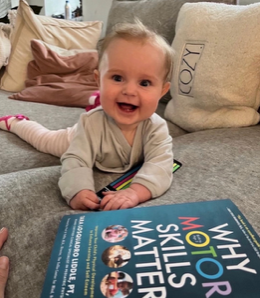
You take your baby to the pediatrician for regular well visits and monitor feeding, growth, sleep, and overall health. But what about movement?
Parents ask me questions all the time. Is my baby moving the way they should? Is it okay that she isn't rolling yet? Why does he always look toward the same side? Does my baby's head look flat? She seems stiff, is that normal? My friend's baby is already sitting. Should mine be? Sometimes there is no obvious developmental delay at all. A parent simply notices something about the way their baby moves and wants someone with expertise in infant movement to take a closer look. That is where a Baby Wellness & Developmental Checkup can be helpful.
You Don’t Have to Wait for a Delay
Parents are sometimes told to “wait and see.” Sometimes waiting is entirely appropriate. Babies develop at different rates, and normal variation is part of development. But there is a difference between thoughtfully giving a baby more time and waiting because no one has taken a close look at how the baby is moving. A Baby Wellness Checkup can help determine whether your baby's development is within an expected range, whether there is something worth watching, and whether a few simple changes at home might help. Sometimes my recommendation is physical therapy. Sometimes it is monitoring. And sometimes I can reassure you that your baby is doing well and doesn't need anything more. You don't need to wait until your baby has clearly missed a milestone before asking questions.
Milestones Matter, But They Don’t Tell the Whole Story
Developmental milestones are useful. Rolling, sitting, crawling, standing, and walking help us understand how development progresses over time. But a milestone tells us primarily what your baby can do. As a pediatric physical therapist, I am equally interested in how your baby does it. Two babies may both sit independently. One may sit comfortably, rotate toward both sides, reach outside the base of support, and transition onto the floor. Another may sit only after being placed there, keep the legs very wide, use the arms constantly for support, and have difficulty moving out of sitting. Both babies technically “sit,” but their movement skills are different. That is why I look beyond a milestone checklist.
What I Look for During a Baby Wellness Checkup
I look at your baby's overall movement rather than focusing on one isolated skill. Depending on your baby's age, I may observe movement symmetry, body tension, muscle tone, trunk control, shoulder and hip stability, midline orientation, weight shifting, tummy time, rolling, sitting, transitions, floor mobility, standing, or early walking. I also pay attention to movement quality. Does movement look relatively easy or require a great deal of effort? Are both sides participating? Does your baby have several ways to move or rely on one strategy? Can your baby get into and out of positions independently? Is movement becoming more varied as development progresses? These observations help me understand much more than whether a milestone has been checked off.
Who a Baby Wellness Checkup Is For
You don't need a diagnosis or an obvious developmental delay to schedule a developmental checkup. You may have noticed that your baby dislikes tummy time, always looks in one direction, has a small head tilt, or is developing some flattening of the head. Perhaps your baby seems unusually stiff or floppy, isn't rolling yet, sits differently than you expected, crawls asymmetrically, or hasn't started walking. A developmental check can also be helpful after prematurity, a NICU stay, breech presentation, a complicated pregnancy or delivery, or when there is a medical or genetic diagnosis. Some parents simply want guidance about baby equipment or want someone who specializes in infant movement to take a look. Wanting reassurance is also a perfectly reasonable reason for a visit.
When Your Baby Is Meeting the Milestones
Your baby may be developing beautifully. A Baby Wellness & Developmental Checkup isn't about searching for something wrong. One of the most valuable things I can provide is reassurance. The movement variation you noticed may fall within typical development. Your baby's timing may be appropriate. You may leave with one or two suggestions and no need for another appointment. I don't believe every baby needs physical therapy. The purpose of the visit is to determine what your baby needs, not to create unnecessary treatment.
Why Parent Observations Matter
You spend more time watching your baby than anyone else. You may be the first person to notice a slight head tilt, a preference for looking toward one side, one hand being used more frequently, or that your baby can sit but can't get into or out of sitting. You may notice that your baby looks very strong but also seems tense. These observations don't automatically mean there is a problem, but they can provide useful information about your baby's movement. When you tell me something looks different, I want to see what you are seeing. Sometimes I identify something worth addressing. Other times I can explain why the movement isn't concerning. Both outcomes can be valuable.
Head Preference and Torticollis
A small head preference can be easy to overlook. Sometimes parents first notice it in photographs because the baby seems to be looking toward the same side in almost every picture. You may notice that your baby's head is slightly tilted or that feeding seems easier on one side. A head preference doesn't automatically mean your baby has torticollis. Persistent asymmetry, however, deserves a closer look because early positional preferences can influence head shape and how your baby begins using the rest of the body. During a Baby Wellness visit, I can assess neck movement, head position, and overall body symmetry.
Head Shape
“Does my baby's head look flat?” is another question I hear frequently.
It can be difficult to judge head shape when you see your baby every day. I look at head shape together with head preference, neck mobility, torticollis, positioning, tummy time, floor movement, baby equipment, and overall motor development. When appropriate, I can also use objective cranial measurements to help assess and monitor head-shape asymmetry. The goal isn't simply to measure your baby's skull. I want to understand why pressure may be repeatedly occurring in one area.
Tummy Time
Many Baby Wellness visits begin with a parent telling me, “My baby hates tummy time.” You may have tried different mats, toys, mirrors, pillows, and positions and still feel as though every attempt ends in crying. Rather than simply telling you to do more tummy time, I want to understand why it is difficult for your baby. Sometimes changing the position, the amount of support, or how you engage your baby can make the experience much more successful.
Body Tension, Stiffness and Arching
Some babies appear remarkably strong because they hold the head high, push forcefully through the legs, or arch the trunk. Other parents describe their baby as tense or difficult to position. I look at whether what you are seeing appears to be a typical movement variation, a strong movement preference, or something that deserves further assessment. I am particularly interested in how easily your baby moves between different positions and whether your baby has a variety of movement strategies rather than relying heavily on one pattern.
Low Muscle Tone
Babies with lower muscle tone may need more time or effort to work against gravity. You may notice that your baby feels floppy, tires quickly, has difficulty with tummy time, sits with a wide base, relies heavily on the arms for support, or has very flexible joints. Low muscle tone and weakness aren't the same thing. During an evaluation, I look at muscle tone together with strength, postural control, joint stability, endurance, and overall motor development.
Sitting Is More Than Staying Upright
Parents sometimes tell me, “My baby sits perfectly.” Then I ask, “Can your baby get into sitting?” That is a different skill.
Independent sitting involves more than remaining upright after someone places your baby there. As development progresses, your baby learns to reach, rotate, recover from a loss of balance, move into side sitting, transition toward the floor, and eventually return to sitting independently. I look at the movement surrounding the milestone, not simply whether your baby can stay upright.
Crawling and Floor Mobility
Not every baby crawls in exactly the same way. Some crawl on hands and knees, some commando crawl, some scoot, and others develop another way to move across the floor. A different crawling pattern isn't automatically a problem. I am more interested in whether your baby shifts weight, uses both sides of the body, rotates through the trunk, moves the arms and legs effectively, transitions between positions, and continues progressing with independent mobility. A Baby Wellness visit can help determine whether the pattern you are seeing is simply developmental variation or something worth addressing.
Standing and Walking
Walking carries enormous emotional significance for families. As the first birthday approaches, questions often increase. Should my baby be standing? Why won't he let go? She cruises everywhere but won't walk. He stands on his toes. She seems afraid to take a step. Before independent walking, I look at all the skills developing underneath it. Can your baby move from the floor toward standing, pull to stand, cruise, squat, shift weight, and balance? How stable are the feet and ankles? How much support does your baby still need? The first independent step is only the visible result of many skills that developed before it.
A Registry or Baby Equipment Review
A Baby Wellness consultation can also be useful before your baby reaches a new developmental stage. Parents often have questions about play mats, highchairs, floor seats, baby carriers, push toys, developmental toys, and equipment for small apartments or play spaces. There is an enormous amount of baby equipment available, and more equipment doesn't necessarily mean better development. Sometimes what your baby needs most is remarkably simple: a safe space on the floor and the freedom to move.
Development Is Not a Race
It is difficult not to compare babies, especially when social media shows one baby crawling at six months and another walking at nine months. Earlier isn't automatically better. I want your baby to develop strength, control, balance, coordination, symmetry, movement variety, and confidence. I am much less interested in racing toward the next milestone. The more useful question is what your baby is learning through movement right now.
What Happens During a Baby Wellness Visit?
We begin by talking. I want to hear what you have noticed, what concerns you, and what your pediatrician has said. Pregnancy and birth history, prematurity, a NICU stay, feeding, reflux, sleep, tummy time, floor play, baby equipment, and previous medical concerns may all provide useful context. Then I watch your baby move. Your baby's age and your specific questions guide the visit. I may look at several positions and activities to understand what your baby can do, how movement is developing, and whether anything needs additional attention.
Standardized Developmental Assessment
When clinically appropriate, standardized assessment can provide useful information about your baby's motor development. But a developmental score is only one part of an evaluation. A baby can technically perform a skill and still show a movement difference worth understanding. That is why I combine standardized assessment, when appropriate, with careful clinical observation. I want to know what your baby can do and how your baby does it.
Baby Wellness and Pediatric Developmental Screening
A Baby Wellness & Developmental Checkup isn't a replacement for your pediatrician's developmental screening or medical care. Your pediatrician remains responsible for your baby's overall health and recommended developmental surveillance and screening. My role as a pediatric physical therapist is different. I take a more detailed look at physical development, including gross motor skills, strength, muscle tone, symmetry, posture, range of motion, head shape, and movement quality. If I identify something that needs additional medical evaluation, I will recommend discussing it with your pediatrician or the appropriate specialist.
Baby Wellness and Early Intervention
A private Baby Wellness consultation also doesn't replace Early Intervention. Early Intervention provides important developmental services for eligible babies and toddlers. A private pediatric PT consultation may complement those services when you want another perspective, a more focused motor assessment, guidance while waiting for an evaluation, help with a specific movement concern, or periodic developmental follow-up. They can serve different purposes and can work together when appropriate.
When Your Baby Doesn’t Need Therapy
Then I will tell you. That may be the best outcome of the visit. You may leave with reassurance, one or two positioning suggestions, a tummy-time modification, guidance about equipment, something specific to watch, or ideas for your baby's next developmental stage. My goal isn't to keep every baby in physical therapy. My goal is to help you understand your baby's movement and know when support is, and isn't, needed.
When I Do Find a Concern
If I identify an area that would benefit from intervention, we can discuss the most appropriate next step. That might mean a short period of physical therapy, periodic developmental monitoring, or a home program. In some situations, I may recommend follow-up with your pediatrician, Early Intervention, orthopedics, neurology, a cranial specialist, or another appropriate provider. The recommendation depends on what I find. Not every concern requires the same response.
Parent Education Is Part of the Visit
I want you to leave understanding your baby better. That means helping you understand why a particular movement may be difficult, why your baby prefers one side, what skill may be developing next, how much help to provide, and when to give your baby time to figure something out independently. We may also discuss whether a particular activity or piece of equipment is actually helping. Parent education shouldn't give you more things to worry about. It should give you useful information that makes supporting your baby's development feel more manageable.
Your Home Should Not Feel Like a Therapy Clinic
Babies learn through everyday movement. Playing, reaching, being carried, moving on the floor, grabbing toys, climbing, falling, and trying again are all part of development. If I give you suggestions, I want them to fit into real family life. You shouldn't feel as though every waking moment has to become an exercise session. We can usually build useful movement opportunities into things you and your baby are already doing.
When to Schedule a Baby Wellness Checkup
There is no single required age for a developmental check. Some families want an early visit during the first few months, particularly after prematurity, a NICU stay, breech presentation, a complicated birth, or concerns about torticollis or head shape. Other families schedule a visit when a new stage raises questions about tummy time, rolling, sitting, crawling, standing, or walking. You don't need to prove that something is wrong before asking for a developmental assessment. If you have a persistent question about your baby's movement, that is enough reason to take a closer look.
When to Contact Your Pediatrician
Always share significant developmental concerns with your child's healthcare provider. I recommend contacting your pediatrician when you notice a loss of a previously acquired skill, significant weakness, marked stiffness or unusual posturing, significant asymmetry, feeding or swallowing concerns, unusual movements, a lack of developmental progression, or a sudden change that concerns you. Physical therapy can be one part of pediatric care. It doesn't replace appropriate medical evaluation.
In-Home Baby Wellness Visits in NYC & the Hamptons
Evaluating your baby at home gives me an important advantage: I get to see the environment where your baby's movement actually happens. We can look at the floor space, toys, baby equipment, tummy-time setup, and the positions your baby uses during everyday routines. That often makes my recommendations more practical because they are based on your actual home rather than a clinic setup. I also offer virtual developmental consultations when they are appropriate for the family's questions and the type of concern.
Why Choose Motor Skills Matter?
I am Dr. Tara Liddle, PT, MA, DPT, PCS, a Board-Certified Pediatric Clinical Specialist with more than 30 years of experience working with babies and children. My background includes 19 years in NICU and neonatal developmental follow-up, giving me extensive experience observing infant movement from the earliest stages of development. I am NDT certified and have advanced training in pediatric movement and neuromuscular treatment. I am the author of Why Motor Skills Matter: Improve Your Child's Physical Development to Enhance Learning and Self-Esteem and a contributing author of the chapter “Physical Therapist Management of Cerebral Palsy” in Contemporary and Global Perspectives in Physical Therapy: Incorporating Clinical Practice Guidelines, published by Springer Nature. My approach combines developmental assessment with careful observation of something that isn't always captured by a milestone checklist: how your baby moves.
Frequently Asked Questions About Baby Wellness & Developmental Checkups
- Does my baby need to have a problem to schedule a visit?
- No. You may have a specific concern or simply want an expert look at your baby's movement and development. A developmental checkup doesn't mean I expect to find a problem.
- What age is best for a Baby Wellness Checkup?
- There isn't one best age. A visit can be useful whenever questions arise, from early tummy time and head control through rolling, sitting, crawling, standing, and walking.
- What if my pediatrician says everything is fine?
- That can be reassuring, and your pediatrician remains central to your baby's care. If you still have a question about movement, symmetry, positioning, or motor development, I can provide a more detailed physical therapy assessment of those areas.
- Is this the same as a developmental screening?
- No. Developmental screening is an important part of pediatric healthcare. A Baby Wellness PT checkup focuses more closely on physical development, movement quality, strength, posture, symmetry, muscle tone, and motor skills.
- Will you tell me if my baby needs physical therapy?
- Yes. If I believe treatment would be helpful, I will explain what I am seeing and why I am recommending it. If I don't believe your baby needs ongoing physical therapy, I will tell you that too.
- Can we schedule just one visit?
- Yes. Some families need only a single consultation.
- Can you check my baby’s head shape?
- Yes. I can evaluate head shape together with neck movement, positioning, and motor development. When appropriate, I can also use objective cranial measurements to help assess and monitor asymmetry.
- Can you review our baby equipment?
- Yes. I can look at how your baby is positioned in equipment you already own and whether it is appropriate for your baby's current developmental stage.
- Can you help with tummy time?
- Yes. Tummy-time difficulty is one of the most common concerns I see during infant developmental visits. Rather than simply telling you to do more tummy time, I look at why it is difficult and how we can make it more successful.
- Can you see premature babies?
- Yes. For babies born prematurely, I consider corrected age together with medical and NICU history, movement quality, muscle tone, and developmental progression.
- Do you offer virtual visits?
- Yes. Virtual consultations can work well for some developmental questions, particularly when you want guidance about positioning, tummy time, floor play, baby equipment, or developmental activities. For concerns that require hands-on assessment, an in-person evaluation may be more appropriate.
Parenting a Baby Comes With a Constant Stream of Questions
Is this normal? Should my baby be doing that? Am I helping enough? Am I helping too much? Do we need therapy, or should we give it more time? The internet can give you a milestone chart. Social media can show you hundreds of other babies. Neither can tell you exactly how your baby is moving. That is the purpose of a Baby Wellness & Developmental Checkup. I can look at your baby, listen to what you have noticed, answer your questions, and identify concerns when they are present. Just as importantly, I can reassure you when they aren’t. You don't need to wait for a developmental delay to become obvious before asking someone with expertise in infant movement to take a closer look. Through Motor Skills Matter, I provide in-home Baby Wellness & Developmental Checkups throughout NYC and the Hamptons, with virtual consultations available when appropriate.
Contact me to schedule a Baby Wellness & Developmental Checkup.