
Expert Evaluation and Support for Your Baby's Movement and Development
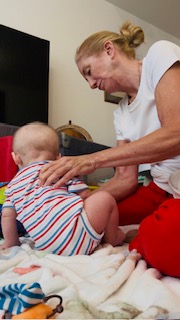
Babies don't all develop on exactly the same timetable. Some move quickly from one skill to the next, while others need more time.
Often, what brings a parent to me isn't simply a missed milestone. You may notice that your baby dislikes tummy time, always looks toward one side, feels unusually stiff or floppy, rolls in only one direction, or seems to work harder than expected to move. Your baby may even be meeting milestones, but something about how they move has caught your attention.
I provide individualized, in-home infant physical therapy and developmental evaluations through Motor Skills Matter in NYC and the Hamptons. My goal is to help you understand what you're seeing, whether your baby's movement falls within expected developmental variation, and whether your baby would benefit from support.
When Might My Baby Benefit From Physical Therapy?
You don't need to wait for your baby to significantly miss a milestone before asking questions. Parents often contact me because they have noticed:
- Difficulty or frustration with tummy time
- A head tilt, strong head-turning preference, or flat or uneven head shape
- Rolling in only one direction or difficulty learning to roll
- Stiffness, body tension, arching, or low muscle tone
- Difficulty reaching, shifting weight, or bringing the hands to midline
- Difficulty sitting or moving between positions
- Delayed or unusual crawling patterns
- Difficulty pulling to stand, standing, or beginning to walk
Sometimes there isn't an obvious delay. You may simply feel that your baby is moving differently. I want to hear what you have noticed. Your observations help me understand what happens during your baby's everyday movement, not just what I see during an evaluation.
Milestones Matter, But How Your Baby Moves Matters Too
Developmental milestones tell me what your baby can do. They don't always tell me how your baby is doing it. Two babies may both sit independently but have very different trunk control, balance, and ability to shift their weight. Your baby may roll but always roll toward the same side. They may sit when placed there but not know how to get into or out of sitting independently. They may pull to stand but rely heavily on their arms or consistently push up through the same leg. During an infant physical therapy evaluation, I look beyond the milestone checklist. I pay attention to movement quality, symmetry, variety, postural control, and how efficiently your baby moves. Those details help me understand what is easy for your baby, what is difficult, and whether a little support could make movement easier.
What I Look at During an Infant Physical Therapy Evaluation
Every baby is different, so I guide the evaluation according to your baby's age, history, current abilities, and your concerns. I may look at head and neck position, muscle tone, body tension, strength, range of motion, postural control, symmetry, midline orientation, weight shifting, and balance reactions. Depending on your baby's age, I also observe tummy time, rolling, reaching, sitting, transitions, crawling or other floor mobility, pulling to stand, standing balance, and emerging walking skills. I also pay attention to how your baby responds to movement and handling. Some babies move easily between positions, while others become uncomfortable or overwhelmed. These responses give me useful information about how best to support your baby.
Pregnancy and Birth History Matter
Pregnancy, birth, and your baby's early newborn experiences can provide useful context. I may ask about prematurity, breech positioning, multiple births, pregnancy or delivery complications, assisted delivery, NICU admission, feeding difficulties, reflux, and early positioning preferences. These factors don't mean your baby will have a developmental difficulty. They simply help me understand your baby's history and whether it may be contributing to what I see.
Infant Physical Therapy for Babies Born Prematurely
If your baby was born prematurely, I consider corrected age when looking at early developmental expectations. I also look beyond age to your baby's muscle tone, symmetry, postural control, movement variety, and overall progression. My background includes extensive experience working with premature and medically complex infants in the NICU and in the neonatal developmental follow-up. Whether you are transitioning home after the NICU or wondering how your baby is progressing several months later, I can help you understand what you are seeing and what to work on next.
Tummy Time Difficulties
Many parents are told their baby needs more tummy time. Sometimes that's easier said than done. Your baby may struggle because of torticollis, body tension, reflux, weakness, low muscle tone, limited head control, or difficulty bearing weight through the arms. If your baby cries every time you place them on their stomach, I want to understand why rather than simply telling you to do more of it. Small changes in positioning and support can make tummy time much more successful.
Muscle Tone, Body Tension and Movement
Parents often describe their baby as stiff, tense, floppy, or difficult to position. I look at how your baby's muscle tone and body tension affect actual movement rather than focusing on a label alone. Can your baby bring the hands toward midline, rotate through the trunk, shift weight, and move comfortably between positions? Can they maintain a position without excessive effort? Do they have several ways to move, or do they rely on the same pattern repeatedly? If your baby frequently arches, stiffens, pushes strongly into extension, or seems unusually tense, I look at the pattern across different positions and activities.
Torticollis, Head Preference and Head Shape
A baby who consistently looks toward one side, tilts the head, or develops flattening on one area of the skull may need more than positioning advice. I look at neck mobility, head position, symmetry, trunk movement, weight shifting, tummy time, and how your baby uses both sides of the body. When head-shape concerns are present, I also consider why your baby's head repeatedly returns to the same position.
Baby Motor Development
Rolling, sitting, crawling, pulling to stand, and walking don't happen on exactly the same schedule for every baby. I am interested in progression as well as timing. If your baby isn't rolling, sitting, crawling, or walking when you expected, I look at the skills that support that milestone. Strength, postural control, weight shifting, rotation, balance, coordination, and confidence can all influence how a new movement develops. Sometimes your baby simply needs more time. Sometimes there is a specific reason progress has slowed.
Baby Equipment and Development
Swings, bouncers, seats, activity centers, and other baby equipment can be useful. I don't expect families to eliminate every piece of equipment. I do look at how your baby is positioned, whether a product fits their current abilities, and how much opportunity your baby has to move freely outside of supported equipment. Sometimes a small change in equipment use creates many more opportunities for movement during the day. Babies learn movement by moving.
What Infant Physical Therapy Looks Like
Infant physical therapy shouldn't look like an adult exercise program. Babies learn through play, repetition, exploration, and interaction. Depending on your baby's needs, I may work on tummy time, reaching, rolling, weight shifting, trunk rotation, sitting, transitions, crawling, kneeling, standing, or early walking. I may also use gentle hands-on techniques when appropriate. I want your baby to participate rather than simply be placed into positions. As your baby develops, I adjust the activities and the amount of help I provide.
Parents Are Part of the Process
I don't want your home to feel like a therapy clinic. Instead of giving you a long list of exercises, I look for practical opportunities within routines you already have. Carrying your baby, changing a diaper, playing on the floor, reaching for a toy, or changing how your baby moves between positions can all become useful developmental experiences. A small change repeated naturally throughout the day can often be more useful than trying to fit another formal exercise session into family life.
Does My Baby Need Ongoing Physical Therapy?
Not necessarily. An evaluation can be helpful even when ongoing therapy isn't needed. Sometimes I evaluate a baby, reassure the family that development looks appropriate, provide a few strategies, and recommend monitoring. Another baby may benefit from a short period of physical therapy to address a specific concern. Babies with more complex developmental, orthopedic, or neurological needs may require more consistent intervention. My goal is not to keep every baby in therapy. I want to identify what your baby needs and provide the appropriate level of support.
In-Home Infant Physical Therapy
Seeing your baby at home gives me an opportunity to observe movement where it naturally happens. I can see your floor-play setup, tummy-time space, toys, seating, and baby equipment. I can also see how your baby moves during familiar routines and make suggestions that work within your actual home environment.
Why Choose Motor Skills Matter?
I am Dr. Tara Liddle, PT, MA, DPT, PCS, a Board-Certified Pediatric Clinical Specialist with more than 30 years of experience working with babies and children. My career includes extensive experience with newborns, premature infants, neonatal developmental follow-up, pediatric rehabilitation, and early motor development. I am NDT certified and have advanced training in pediatric movement and neuromuscular treatment.
I am the author of Why Motor Skills Matter: Improve Your Child's Physical Development to Enhance Learning and Self-Esteem and a contributing author of the chapter “Physical Therapist Management of Cerebral Palsy” in Contemporary and Global Perspectives in Physical Therapy: Incorporating Clinical Practice Guidelines, published by Springer Nature. My approach combines evidence-informed pediatric physical therapy with decades of clinical observation. Milestones matter, but I also pay close attention to how your baby learns to move.
Frequently Asked Questions About Infant Physical Therapy
- My baby hasn't missed a milestone. Can I still have them evaluated?
- Yes. You may be concerned about asymmetry, stiffness, low muscle tone, tummy time, or simply how your baby is moving. Your baby doesn't need to have a significant developmental delay for an evaluation to be useful. Sometimes an evaluation provides reassurance and a few practical suggestions, and that is all a family needs.
- What if my baby cries during the evaluation?
- Babies cry, get hungry, need breaks, and don't always feel like participating. I adapt the evaluation to your baby rather than expecting them to perform on demand. How your baby responds to handling, positioning, and movement also gives me useful information.
- Should I use my baby's corrected age if they were premature?
- I generally consider corrected age when looking at early development in babies born prematurely. I also consider gestational age, medical history, muscle tone, movement quality, and individual developmental progression rather than relying on corrected age alone.
- How often will my baby need physical therapy?
- There isn't one schedule that is right for every baby. I base my recommendation on your baby's age, what I find during the evaluation, medical or developmental needs, your family's needs, and how your baby responds. Some babies need only an evaluation and guidance. Others benefit from a short period of therapy, while babies with more complex needs may need ongoing care.
- Can you help me decide which baby equipment to use?
- Yes. I can look at the equipment you already have or are considering and help you decide whether it fits your baby's current abilities and supports useful movement opportunities. Sometimes the best developmental option is also the simplest: a safe space on the floor and the freedom to move.
Wondering About Your Baby's Development?
You don't have to wait until a concern becomes a significant delay. If your baby dislikes tummy time, seems unusually stiff or floppy, consistently favors one side, is having difficulty with an emerging milestone, or you would simply like an expert opinion about how your baby is moving, I can evaluate your baby and help you understand what you're seeing. Motor Skills Matter provides expert in-home infant physical therapy and developmental evaluations in NYC and the Hamptons.
Schedule an infant physical therapy evaluation with Dr. Tara Liddle.